Google
 

Tuesday, January 1, 2008

Space Weather

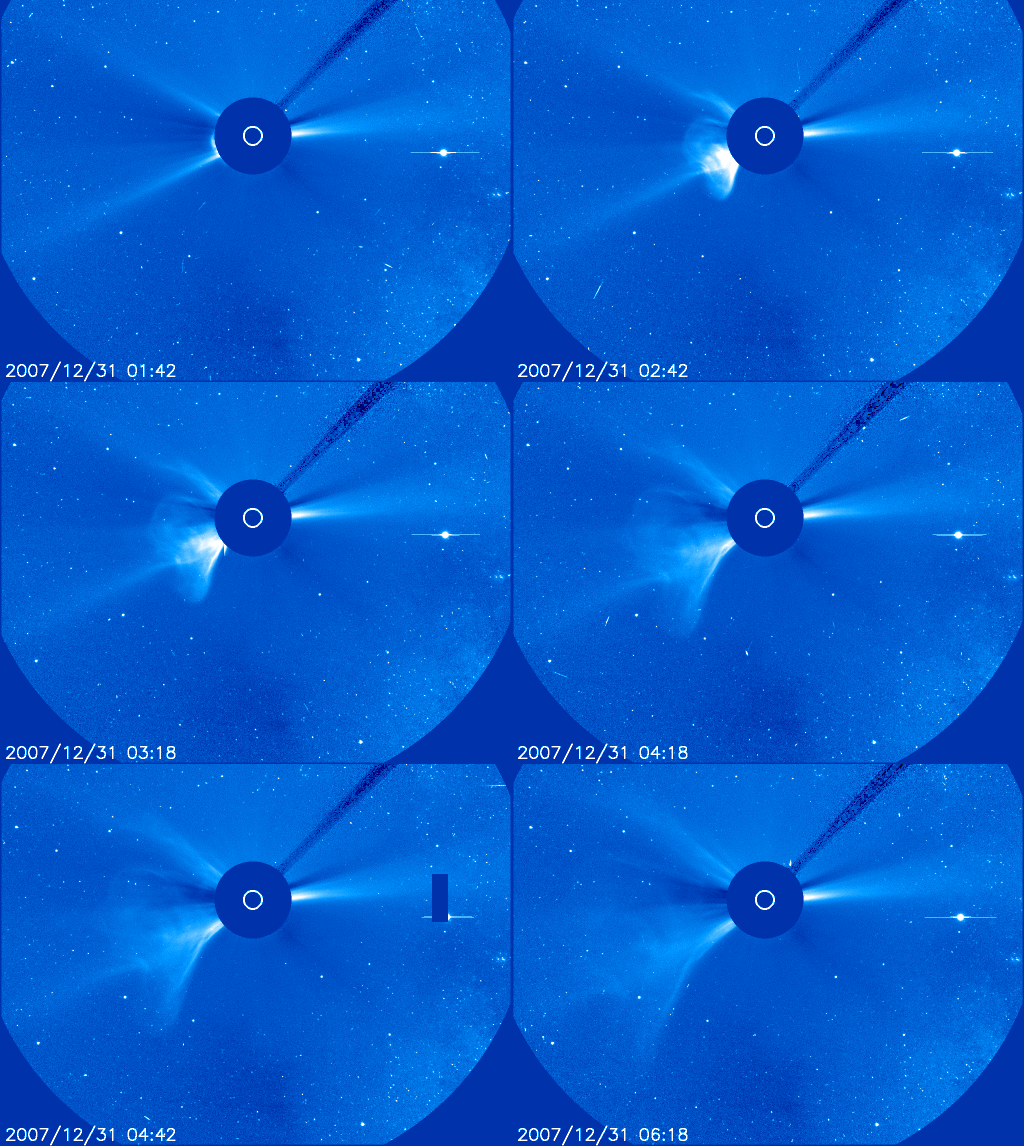
SOLAR ACTIVITY: On Oct. 31st around 0110 UTC, something exploded just behind the sun's eastern limb. The blast unleashed a C8-class solar flare and hurled a bright CME into space. These events may signal the impending return of large sunspot 978, which has spent the past two weeks transiting the far side of the sun.

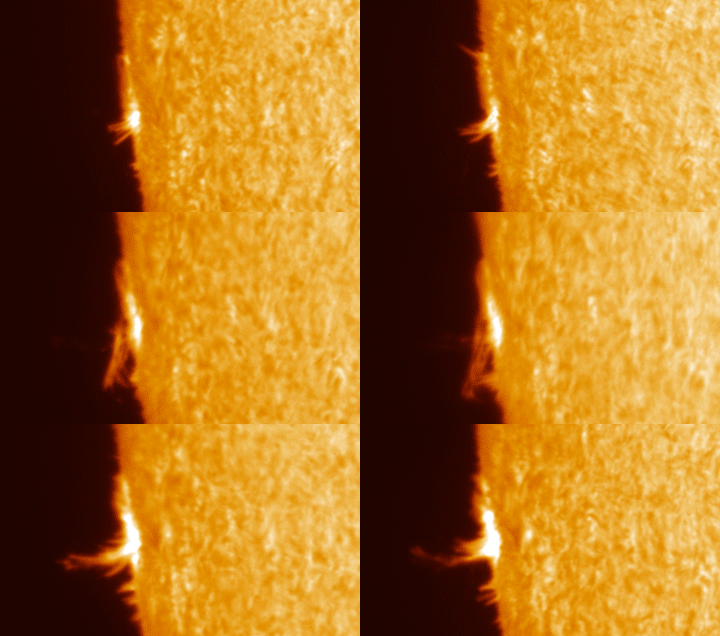
Almost a full day after the explosion, astrophotographer Gary Palmer of Los Angeles trained his SolarMax90 on the eastern limb of the sun and saw "no more flares, but plenty of undulating plasma."

The blast site is still seething with activity. But what is it? An old sunspot? An unstable magnetic filament? We should get a better view later today or tomorrow as the sun's rotation brings the tempest over the limb into a direct line of sight from Earth. Stay tuned for updates.

more images: from John Nassr of Baguio, the Philippines

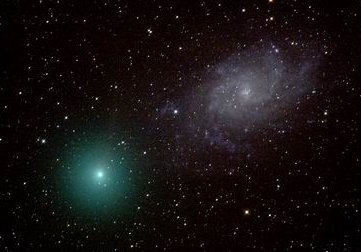
HEAVENLY MEETING: On Sunday night, Oct. 30th, Comet 8P/Tuttle passed by spiral galaxy M33. It was, well... a picture is worth a thousand words:


more galaxy-comet encounter photos

"The emerald-colored comet and M33 were a fantastic late Christmas gift for me," says Gerald DeShirlia who photographed the encounter from his drive way in Wimberley, Texas, using a 7-inch refracting telescope and a Canon 20D digital camera.

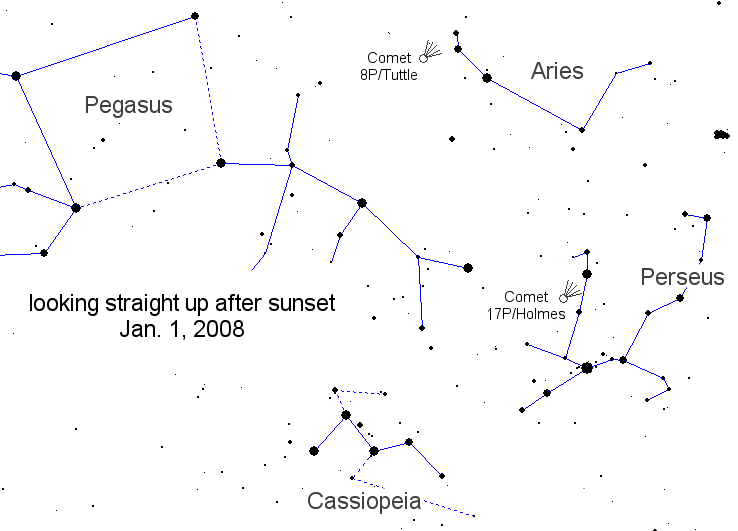
Now Comet 8P/Tuttle is heading toward Earth. On Jan. 1st and 2nd it makes its closest approach to our planet--only 24 million miles away. The emerald-colored comet will brighten to a predicted magnitude of 5.8, visible to the unaided eye from dark-sky sites and a fine target for backyard telescopes: sky map.

Space.com : The Enduring Mysteries of the Outer Solar System


By Charles Q. Choi
Special to SPACE.com
posted: 31 December 2007
7:00 a.m. ET

The farthest reaches of our solar system remain the most mysterious areas around the sun. Solving the mysteries of the outer solar system could shed light on how the whole thing emerged — as well as how life on Earth was born.

Why the rainbow of colors in the Kuiper belt?

For instance, the Kuiper belt past Neptune is currently the suspected home of comets that only take a few decades or at most centuries to complete their solar orbits — so-called "short-period comets." Surprisingly, Kuiper belt objects "show a wide range of colors — neutral or even slightly blue all the way to very red," said University of Hawaii astrophysicist David Jewitt.

The color of an object helps reveal details about its surface composition. It remains a mystery why Kuiper belt objects show a much wider range of color — and thus surface composition — than other planetoids, such as the asteroids.

Some researchers had suggested volcanic activity could have led to all these colors — "absurd in the context of 100-kilometer-sized (60-mile) bodies," Jewitt said, as volcanism needs something bigger.

Jewitt and his colleagues had suggested that cosmic rays could have made Kuiper belt objects redder, while impacts with rocks could have dug up more pristine matter that made them less red. Nowadays Jewitt thinks there must be another explanation for this rainbow, but it remains unknown.

What is ultra-red matter?

There appears to be a material dubbed "ultra-red matter" that exists only on about half of all Kuiper belt objects and their immediate progeny, known as centaurs — icy planetoids orbiting between Jupiter and Neptune that very recently escaped from the Kuiper belt.

This ultra-red matter does not exist in the inner solar system, "not even on the comets which come from the Kuiper belt. This suggests that the ultra-red matter is somehow unstable at the higher temperatures close to the sun," Jewitt explained.

The red colors suggest this substance might contain organic molecules. Comets and other planetoids are often thought to have helped bring organic molecules to Earth.

"In the Kuiper belt objects, organics might have been 'cooked' by cosmic ray radiation, giving them dark red surfaces, but there is no proof," Jewitt said. Ideally spacecraft could go out there and find out, he added.

Has the Kuiper belt shrunk?

Theoretical calculations suggest the Kuiper belt was once hundreds or maybe even thousands of times more populated than it is now. "How was 99 percent or 99.9 percent of the mass lost, and when?" Jewitt asked.

One conjecture suggests when Saturn and Jupiter shifted their orbits roughly 4 billion years ago, their gravitational pulls slung Kuiper belt objects out of the solar system. Another says the Kuiper belt objects pulverized themselves to dust, which then was swept away by the sun's radiation. Yet another possibility "is that we are missing something crucial and the conclusion that the belt is heavily depleted is wrong," Jewitt said. "All these possibilities are comparably hard to swallow, but would each be amazing, if true."

Secrets in the Oort cloud?

A distant reservoir of trillions of comets known as the Oort cloud theoretically lies up to 100,000 astronomical units from the sun — an astronomical unit or AU being about 93 million miles (150 million kilometers). This means the Oort cloud is a fifth of the way to the nearest star, so far away that objects within it have never been seen directly, only inferred — but it must exist, given all the comets seen over the years.

The Oort cloud is the conjectured source of comets that require centuries or millennia to complete their long journeys around the sun. Since these "long-period comets" come from all directions, the Oort cloud is often thought to be spherical. However, while comets such as Halley's do not come from the Kuiper belt, their orbits also do not jibe with a spherical Oort cloud, Jewitt explained. This suggests there may be an "inner Oort cloud" shaped kind of like a doughnut.

Astrophysicists think the Oort cloud is a remnant of the protoplanetary disk that formed around the sun roughly 4.6 billion years ago. Learning more about the Oort cloud could shed light on how our solar system — and Earth — were born, Jewitt said.

Are there more dwarf planets?

So far, three dwarf planets are recognized — Ceres, Pluto and Eris. The Kuiper belt, which lies about 50 AU from the sun, could hold some 200 more. Beyond that there could be scores of dwarf-planet-sized bodies beyond roughly 100 AU from the sun "that nobody had seen before due to their faintness and slow motion," said astronomer Chad Trujillo at Gemini Observatory in Hawaii. "Even a body as big as Mars could be missed in our current surveys if it were moved beyond a couple hundred AU."�

Trujillo noted projects such as Pan-STARRS (Panoramic Survey Telescope And Rapid Response System) and the LSST (Large Synoptic Survey Telescope) "should fill this gap in our knowledge in the coming decade."

Where do the dwarf planets come from?

There are theories that the dwarf planets of the outer solar system may have dwelt in the inner solar system billions of years ago, based on their current orbital trajectories. If so, "why are there so many ices on their surfaces?" Trujillo asked. Bodies in the inner solar system are generally expected to lose their ice due to sunlight.

Trujillo and his colleagues suspect the ice now seen on these dwarf planets is relatively new, with such replacement ice coming perhaps from within these worlds, erupting out during "cryovolcanism." Of course, further research is needed to see if such ice renewal would be enough to cover the dwarf planet after they voyaged from the inner to the outer solar system, he added.

Do cosmic rays come from a bubble around the solar system?

When the supersonic wind of charged particles that flows from our sun collides with the thin gas found between the stars, the solar wind essentially blows a bubble in this interstellar medium — a ball known as the heliosphere.

Scientists have thought unusually weak cosmic rays — energetic particles that zip from space at Earth — come from the heliosphere. Specifically, these rays are thought to come from the "termination shock" — a shock wave of compressed, hot particles that results when the solar wind abruptly brakes against interstellar gas. (The termination shock appears to be about 75 to 85 AU from the sun.)

However, Voyager 1 saw no sign these anomalous cosmic rays were produced at the termination shock. "Perhaps it crossed the shock at the wrong time or place," said MIT astrophysicist John Richardson, or perhaps the standard view on how these anomalous cosmic rays are generated is wrong. Voyager 2 crossed the termination shock in 2007 about 10 billion miles away from where Voyager 1 crossed it in 2004, and its data, which is still being analyzed, "may help us understand where these particle are produced," he explained.

"Cosmic rays have been reported to affect Earth's weather so understanding their source is important," Richardson added. Moreover, high-energy particles from shock waves triggered by huge eruptions from the sun known as coronal mass ejections can damage spacecraft and astronauts, and better understanding the termination shock could help understand these other, potentially dangerous particles.

Sunday, December 30, 2007

NASA : SERVIR: NASA lends a hand in Central America

Dec. 28, 2007: Earlier this year, NASA researcher Dan Irwin stepped off a plane in Guatemala and found, to his surprise, that he was running for mayor. It seems the people of San Andres had put his name on the ballot.

Irwin respectfully declined, but he was touched. If you ask him why the residents of rural San Andres are crazy about him, Irwin, a humble soul, shrugs his shoulders and says, "Everyone has a hobby. Mine is building things – helping develop their community. I enjoy it."

see captionIrwin is a pioneer of SERVIR (Spanish for "to serve"), a high-tech satellite visualization system that monitors the environment of Central America. It helps track and combat wildfire, improves land use and agricultural practices, and helps local officials respond faster to natural disasters.

Right: During a recent visit to Central America, Dan Irwin explains the inner workings of SERVIR to NASA Deputy Administrator Shana Dale. [more]

Developing SERVIR was a full-time job for Alabama-resident Irwin, including many months on assignment in Central America. What do you do in your spare time so far from home? With the help of community residents, Irwin built a playground and a library in San Andres. "I worked on the projects before and after work and on weekends," says Irwin, "just as other people spend time on their hobbies at those times."

But it is Irwin's "real" work with SERVIR that makes contributions reaching far beyond the community level to the whole of Central America.

"SERVIR has brought together a lot of different people from a lot of different backgrounds to create the kind of team needed to help solve very complex issues and provide potentially life-saving solutions to local decision makers and stakeholders," says John Horack of NASA's Marshall Space Flight Center (MSFC) where SERVIR technology is developed and tested.

SERVIR's supercomputer at the Water Center for the Humid Tropics of Latin America and the Caribbean (CATHALAC) in Panama City integrates data from a variety of sources and displays a real-time map of crisis points. At a glance, decisions-makers can see where rain will fall, where flooding will occur, the location of forest fires, hurricanes, tornadoes – pretty much anything nature can dish out. CATHALAC then warns residents.

see caption

Above: SERVIR brings high-tech satellite imagery and visualization tools to bear on Central America. Current maps of fire, floods and severe weather may be found on the bilingual SERVIR web site: http://servir.net.

SERVIR also takes a global approach to environmental challenges by supporting the ten-year plan for implementation of the Global Earth Observation System of Systems, or GEOSS, which was adopted by the European Commission and over 70 governments worldwide.

GEOSS's main purpose is to foster cooperation and integration among countries by pooling Earth observation tools and data for the benefit of all. Because of SERVIR's positive impact in Central America, GEOSS recently adopted SERVIR as their template--a sort of "poster child" for how to meet GEOSS goals. At the organization's recent Ministerial Summit in Cape Town, South Africa, which was attended by over 70 nations and over 50 international organizations, SERVIR was recognized as a "GEOSS Early Achievement."

What's the secret to SERVIR's success? It's not "what" but "who" – namely, Irwin and what he calls the "dream team."

see caption
Above: The SERVIR "dream team." [Larger image]

These behind-the-scene "wizards" include administrators, scientists, and technicians like, at CATHALAC, Director Emilio Sempris, Emil Cherrington, and Francisco Delgado; and, at NASA's Marshall Space Flight Center, Burgess Howell, Robert Griffin, and Jason Arnold.

The CATHALAC team members are in charge of day-to-day on-site operations: gathering and processing the satellite data, combining it with ground observations, and getting the results quickly into the hands of national environmental management and disaster response leaders. Team members at the MSFC test-bed facility view SERVIR data at the same time as their Central American counterparts view it and play key roles in supporting and coordinating SERVIR projects.

"I'm involved at several different levels within SERVIR," says team member Griffin. "I help coordinate among institutions in a country as well as with SERVIR and its partners in the U.S. and abroad. As with everyone involved with these projects, I help create products to solve problems in the event of a natural disaster."

see captionAll of the SERVIR team members will help achieve the next important step -- geographic expansion. NASA is extending SERVIR's life-saving benefits to Africa and the Caribbean. SERVIR’s flexibility and adaptability make it perfect for meeting the new challenges of these geographic areas, helping NASA and its partners bring global technology to the grass roots level.

Right: A SERVIR "test bed node" at the National Space Science and Technology Center in Huntsville, AL. [Larger image]

"This is an extremely exciting time to be a part of this project," says Griffin. "Right now, I'm working to deploy SERVIR in the Dominican Republic. Most recently we brought together radar imagery and other information to help the Dominican Republic's government respond to extensive flooding in the wake of Tropical Storm Noel."

Says Irwin of Griffin and other members of the team, "all of these people are indispensable to all that we've done and will continue to do. Without them, it would be impossible."

It's no wonder that Irwin reveres the SERVIR team, and that many Central Americans revere Dan Irwin.
Space.com : The Winter Sky: Planets, Stars and Cool Shapes


By Joe Rao
SPACE.com Skywatching Columnist
posted: 28 December 2007
01:17 pm ET

December is the month of the winter solstice, which a large part of mankind associates with such festivals as the Nativity. Among the many varied customs linked with this special season for thousands of years, the exchanging of gifts is almost universal.

The moment of the solstice occurred on Dec. 22 at 1:08 a.m. EST. The sun, appearing to travel along the ecliptic, reached that point in the sky where it is farthest south of the celestial equator.

Mother Nature herself offers the sky observer in north temperate latitudes the two gifts of longest nights and a sky more transparent than usual.

One reason for the clarity of a winter's night is that cold air cannot hold as much moisture as warm air can. Hence, on many nights in the summer, the warm moisture-laden atmosphere causes the sky to appear hazier. By day it is a milky, washed-out blue, which in winter becomes a richer, deeper and darker shade of blue. For us in northern climes, this only adds more luster to that part of the sky containing the beautiful wintertime constellations. Indeed, it is seemingly nature's holiday decoration to commemorate the winter solstice and enlighten the long cold nights of winter.

First rule: Bundle up!

If you plan to be outside for a long period of time on these frosty, cold nights, remember that enjoying the starry winter sky requires protection against the prevailing low temperatures. One of the best garments is a hooded ski parka, which is lightweight yet excellent insulation, and ski pants which are better than ordinary trousers. And it is also important to remember your feet. While two pairs of warm socks in loose-fitting shoes are often adequate, for protracted observing on bitter-cold nights wear insulated boots.

From dusk to dawn

Soon after sunset, we can enjoy the sight of the brightest evening planet, Mars, shining brilliantly in the east-northeast sky. It fades ever-so-slightly since its Christmas Eve opposition brilliance to magnitude -1.5.

Still, this is a trifle brighter than Sirius, the brightest star in the sky, which itself will be coming up over the east-southeast horizon soon after 7 p.m.

Saturn rises soon after 9 p.m. from the east-northeast, a bright yellowish-white interloper among the stars of Leo, the Lion. If you received a telescope as a holiday gift, you'll be able to glimpse Saturn's famous ring system with a magnification as low as 30-power. Currently, the rings are tipped only about 7 degrees to our line of sight, but as the winter progresses they'll be opening up a bit more. On Dec. 20, Saturn began its retrograde motion – reversing its course against the background stars and appearing to move back to the west toward Leo's brightest star, Regulus (which it will almost reach by next spring).

And if you're still up in the predawn morning hours, you'll see Venus, the brightest of all the planets, emerging from the east-southeast horizon like a brilliant silvery "star" soon after 4 a.m.

High toward the south, also at around 10:30 p.m., we see what astronomy author Hans A. Rey (1898-1977) called a "Great Hexagon" of bright winter stars. To the south and a little east lies Sirius; up to the west, Rigel. Still higher, reddish Aldebaran; then at the north end of the circle, Capella. South and slightly east, we come to Castor and Pollux, the heads of the Gemini twins. Finally, south again to Procyon: in all, seven bright stars in six constellations.

In the center of the hexagon, more or less, you have the ruddy star Betelegeuse, while soaring high above Orion, between the horns of Taurus is pumpkin-hued Mars; an interloper this winter season. This is the rich region that gives the winter sky its splendor.

Joe Rao serves as an instructor and guest lecturer at New York's Hayden Planetarium. He writes about astronomy for The New York Times and other publications, and he is also an on-camera meteorologist for News 12 Westchester, New York.

Space.com : Stepping Forward: The Year in Spaceflight


By Tariq Malik
Staff Writer
posted: 27 December 2007
7:00 a.m. ET

It's been a busy year for spaceflight in the U.S. and around the world, with an even more ambitious slate ahead for 2008.

On the home front, NASA launched three shuttle missions to the International Space Station (ISS), where astronauts laid the framework for new European and Japanese laboratories set to fly next year even as they uncovered new glitches with the outpost's solar arrays.

"I think that we have accomplished a lot post-Columbia, and that this last year has been our proving ground," said the space station's current commander Peggy Whitson, the first female ISS skipper, this month.

Malaysia's first astronaut and a record space tourist flight also launched toward the ISS in 2007, which saw a myriad of science probes rocket spaceward while the Space Age turned 50. China and Japan also made great strides this year, launching their first moon probes as both countries prepare to send crewed spacecraft into orbit next year.

Orbital construction leaps forward

While a freak hail storm in February delayed the start of NASA's shuttle flight plan for months, the U.S. agency bounced back to complete three missions that added new solar arrays, truss segments and the Harmony connecting room to the ISS.

Astronauts moved old, massive trusses, stitched up torn solar wings and overcame crippling computer glitches while outfitting the ISS with new segments. Engineers are currently grappling with the station's balky starboard solar wing joints, with repairs slated for sometime next year.

"Obviously, it hasn't gone along flawlessly, but that's part of the process too," said Whitson, adding that only by tackling such challenges will humanity learn how to better explore space.

The construction work culminated in a November marathon of spacewalks and robotics by Whitson and her crewmates to ready their station for a fourth shuttle flight—since delayed—bearing Europe's Columbus laboratory. Columbus will dock at the station's Harmony node, the first new room to arrive at the ISS since 2001.

"The activity we just did on [the] station is probably the most complicated assembly we have ever done," said William Gerstenmaier, NASA's associate administrator for space operations. "And all that has worked precisely as we needed it to work."

NASA plans up to 12 more shuttle flights to complete ISS construction, plus one more to the Hubble Space Telescope, before its three-orbiter fleet retires in 2010. Six shuttle flights are currently on NASA's docket for 2008.

"I think we've got easily the capability to go fly the four flights a year that we need to do to complete our manifest," Gerstenmaier said.

Asian Space Race

China began this year with a bang, literally, when it destroyed a defunct communications platform during a January anti-satellite test that spurred widespread criticism from countries around the world.

"They really do seem to have been caught off guard," said China space specialist Dean Cheng, a senior Asia analyst with CAN Corp. in Arlington, Va., of the country's surprise from the protests. "And the damage control efforts that they've undertaken have, frankly, been poor."

But the test kicked off a busy launch period for China and Japan capped by the near launches of separate lunar orbiters—Chang'e 1 and Kaguya, respectively—to explore the surface of the moon. The year also saw Malaysia's first astronaut launch to the ISS aboard a Russian spacecraft and return during a harrowing ballistic descent with two professional cosmonauts.

"This was, in a sense, the first wave of Asia's jump into space," Cheng said of 2007. "This is not a high-impact, pedal-to-the-metal kind of race."

Unlike the Space Race between the U.S. and former Soviet Union, the international competition for space prowess in Asia reaches past national prestige, he added.

"The Chinese are still, for better or worse, head and shoulders above the rest simply because they're putting up their own astronauts up on their own vehicle," Cheng said.

China is the third country, after Russia and the U.S., to build and launch spacecraft capable of carrying astronauts into orbit.

South Korea's first astronaut is slated to launch to the space station atop a Russian rocket in 2008 after, if all goes well, Japanese astronauts visit the ISS to help install segments of their country's massive Kibo laboratory. When fully assembled, Kibo will be the largest single lab attached to the ISS.

Meanwhile, China is gearing up to launch its third manned spaceflight, with three astronauts and a planned spacewalk, in fall 2008.

"These countries are competing with each other to say, 'We are a first world, first rate, aerospace and scientifically advanced country,'" Cheng said. "Take us seriously, invest in us, hire our people, all of those factors. And I think in the next several years you're going to see an even higher growth rate."

The road ahead

While national space agencies made steady progress, commercial firms met with mixed results highlighted by Bigelow Aerospace's successful second launch of a prototype space station and the tragic explosion that killed three and wounded three others.

NASA is banking on advances in commercial spaceflight to help bridge the anticipated years-long gap between the space shuttle fleet's retirement and the first flights of its replacement—the Orion Crew Exploration Vehicle.

The U.S. space agency completed awarding contracts for the spacecraft's Ares I rocket among other milestones, with the first abort test flights planned for 2008.

"[I]t's been an important year for us," Whitson said. "And I'd like to think that it's been very successful."

Univers eToday : Quadrantid Meteor Shower Will Sparkle on January 3rd

Written by Tammy Plotner

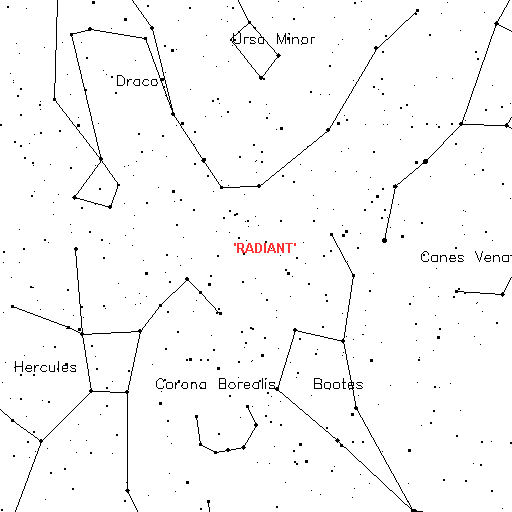
Quadrantid Meteor Shower RadiantBeginning each New Year and lasting for nearly a week, the Quadrantid Meteor Shower sparkles across the night sky for nearly all viewers around the world. Its radiant belongs to an extinct constellation once known as Quadran Muralis, but any meteors will seem to come from the general direction of bright Arcturus and Boötes. This is a very narrow stream, which may have once belonged to a portion of the Aquarids, but recent scientific data points to a what may have been a cosmic collision.

According the most recent data, the Quandrantid meteors may have been formed about five centuries ago when a near-Earth asteroid named 2003 EH1 and a comet smashed into one another. Historic records from ancient China put comet C/1490 Y1 in the path of probability. As Jupiter's gravity continues to perturb the stream, another 400 years may mean this shower will become as extinct as the constellation for which it was once known… But NASA scientists and astronomers are taking to the skies to study the event.

A Gulfstream V aircraft will fly scientists and their instruments for 10 continuous hours over the Arctic to observe and record meteor activity. From above the Earth, the stream can be studied without light pollution and clouds to determine when the activity peaks and how the stream is dispersed. “We will fly to the North Pole and back to compensate for Earth's rotation and to keep the stream in view throughout the flight,” said Peter Jenniskens, a principal investigator at NASA's Ames Research Center.

According to NASA, scientists believe this could be the most brilliant meteor shower in 2008 with over 100 visible meteors per hour at its peak. Best viewing times with the highest meteor rates are expected to be in either the late evening of Jan. 3 over Europe and western Asia or the early morning of Jan. 4 over the eastern United States. For the USA: 6pm – 2am (Pacific Time) on Jan. 3 and 4, 2008. For Northern Europe: 2am – 10am (London) on Jan. 4, 2008. For Northern Asia: 11am – 7pm (Tokyo) on Jan. 4, 2008. For almost of us, this means bundling up against the cold and battling the remnants of the waning Moon… But the sight of even one "shooting star" can make the trip worthwhile!

Will the Quadrantid Meteor Shower live up to its expectations? No one knows for sure… But we'll be watching!

Universe Today : Podcast: Globular Clusters

Written by Fraser Cain

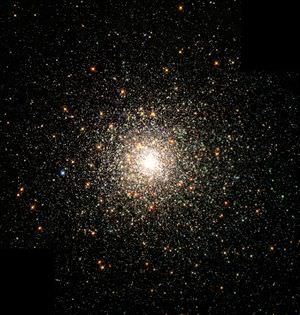
M80
This week we're going to study some of the most ancient objects in the entire Universe; globular clusters. These relics of the early Universe contain hundreds of thousands of stars, held together by their mutual gravity. Since they formed together, they give astronomers a unique way to test various theories of stellar evolution.

Click here to download the episode

Globular Clusters - Show notes and transcript

Or subscribe to: astronomycast.com/podcast.xml with your podcatching software.

Universe Today : Book Review: Rocketeers

Written by Mark Mortimer

Rocketeers
People as a group don't get credit for making great advances. Individuals are the ones who rise above the background noise of humanity, and their suggestions or offerings provide a new thrust for our civilization. Edison brought ready energy to peoples' houses; the Wright brothers brought ready transport across vast distances. Michael Belfiore in his book Rocketeers – How a Visionary Band of Business Leaders, Engineers, and Pilots is Boldly Privatizing Space gives identity to some of today's individuals who are trying to rise above. His is the story of these individuals who want to enable the ready travel of people beyond Earth's atmosphere.

Just recently, SpaceShipOne won the Ansari X Prize by privately funding a craft that could rise to more than 328,000 feet. Belfiore sees this as a starting point to a grand adventure for humankind. He claims, and writes, how individuals are able to accomplish tasks once solely in the realm of government. These few people, with great drive and smarts, set their special skills to attaining a specific goal. And some, almost miraculously, achieve it. The author also describes how most of these people, if not all, have great expectations on seeing their results become a cornerstone to another, new vibrant industry.

In this book, Belfiore is, if nothing else, amazingly vibrant and cheerful. Think, a cheerleader on steroids after drinking an overly caffeinated drink. He glamourizes imagery and enlightens background situations. In doing, he leaves no doubt as to the challenge of building rockets, the risk with flying them and the utmost joy upon a mission's success. He relays the fear of having a plane door flap open during flight, the amazement of using a rocket to power a bicycle, and the dejection of months of effort evaporating with the failure of one small, relatively inexpensive, component. Within this book, everything is happening immediately, in front of the reader. Great distances and many people dash by, as the book follows the author while he visits airfield operators, financial underwriters and rocket developers. He conveys the feeling of no time to waste, as in any start-up industry.

This traveling about by the author is the greatest appeal to this book. Belfiore includes passages that show he hasn't just read clippings and then written a book. Rather, he's gone out, met the people and got first hand information. He writes of meetings with Bigelow, Feeney, Ansari and many others. He describes many of the manufacturing facilities, test sites and mock-ups which he visited. Included within the book are photographs and fun anecdotal events to back up these travels. With these, the book really comes alive for the reader. The reader becomes part of the working group gathered around the restaurant table, all drawing schematics on paper napkins.

But, this optimism and vibrancy throughout the text makes for a very one-sided appreciation of the undertaking. Entrepreneurs and experimenters with near-limitless funding or with connections to wealthy benefactors are all nearly eulogized as being the best. The government comes across as lost, misdirected or obstructionist. Further, there's only reference to efforts in the United States. Therefore, as wonderful as this will read for any rich citizen in the United States, others may have some difficulty in sharing in the excitement and hope. Given references to one hundred thousand dollar tickets to fly to orbit and back, most people on this planet will never experience this pleasure. Hence, though Belfiore is careful to write that the goal is to benefit all humankind, the book's details impart a different story.

Hence, if a reader is very much into space and rocket travel, this book is great fun. Rocket plane races, weddings in space and orbiting hotels make for exciting visions of the future. Those readers who perhaps dwell deeper in the practicalities will find this book a bit overly optimistic and thin. But, anyone who enjoys fast paced, lively writing on technical subjects will enjoy this book probably as much as Belfiore says he had in gathering the information.

Working for the future allows us to put substance into our dreams. Waiting for a finished product to service our longings may mean never doing it. In Rocketeers – How a Visionary Band of Business Leaders, Engineers, and Pilots is Boldly Privatizing Space, Michael Belfiore writes of those doing the deed rather than waiting for a provider. For them, a ticket to ride can never come soon enough and their dreams may just enable ours.

Read more reviews or purchase a copy online from Amazon.com.

universe Today : SoHO Celebrates its 12th Birthday

Written by Ian O'Neill

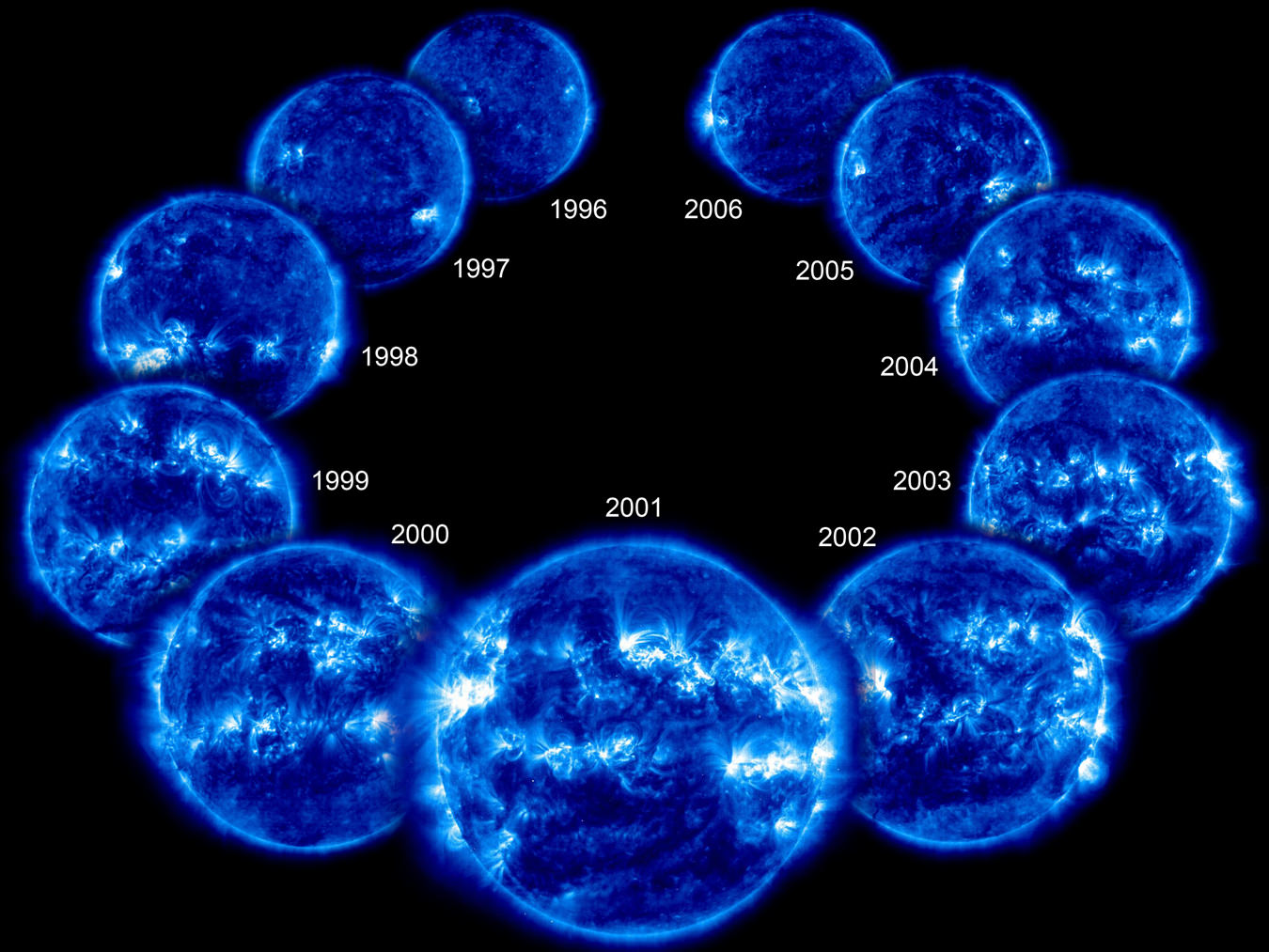
171A, EIT (SoHO) collection of solar images through the solar cycle
On December 2nd, 1995 a large joint ESA and NASA mission was launched to gain an insight to the dynamics of the Sun and its relationship with the space between the planets. 12 years on, the Solar and Heliospheric Observatory (SoHO) continues to witness some of the largest explosions ever seen in the solar system, observes beautiful magnetic coronal arcs reach out into space and tracks comets as they fall to a fiery death. In the line of duty, SoHO even suffered a near-fatal shutdown (in 1998). As far as astronomy goes, this is a tough assignment.

By the end of 1996, SoHO had arrived at the First Lagrange Point between the Earth and the Sun (a gravitationally stable position balanced by the masses of the Sun and Earth, about 1.5 million km away) and orbits this silent outpost to this day. It began to transmit data at "solar minimum", a period of time at the beginning of the Solar Cycle, where sunspots are few and solar activity is low, and continues toward the upcoming solar minimum after the exciting firworks of the last "solar maximum". This gives physicists another chance to observe the majority of a Solar Cycle with a single observatory (the previous long-lasting mission was the Japanese Yohkoh satellite from 1991-2001).

On board this ambitious observatory, 11 instruments constantly gaze at the Sun, observing everything from solar oscillations (“Sun Quakes”), coronal loops, flares, CMEs and the solar wind; just about everything the Sun does. SoHO has become an indispensable mission for helping us to understand how the Sun influences the environment around our planet and how this generates the potentially dangerous “Space Weather”.

The SoHO mission site confidently states that SoHO will remain in operation far into the next Solar Cycle. I hope this is the case as the new Hinode and STEREO probes will be good company for this historic mission.

Source: NASA News Release

Universe Today : 1-in-75 Chance Of Tunguska-Size Impact On Mars

Written by Ian O'Neill

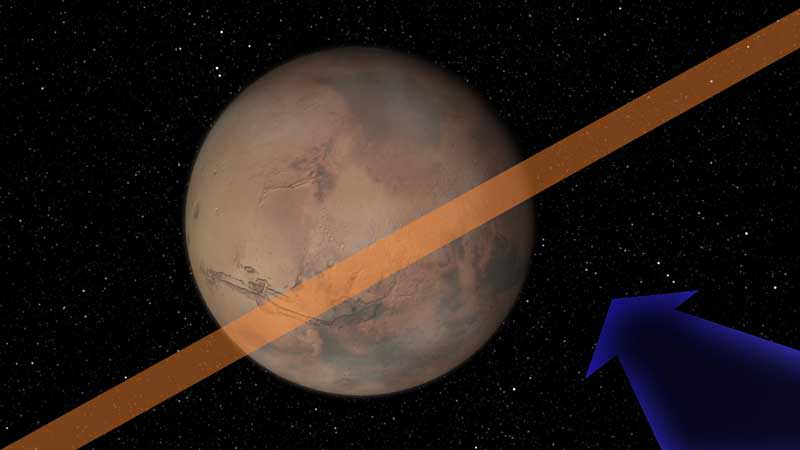
Artists impression of the zone of where 2007 WD5 could impact with Mars (credit: NASA/JPL)
A 164-foot (50 meter) wide asteroid will be crossing the orbit of Mars at the end of January 2008. Currently, there is a 1-in-75 chance of the "Mars Crosser" hitting the Red Planet, and if it does, the 30,000 mile per hour speeding mass would generate a three megaton explosion (approximately the size of the terrestrial Tunguska impact over Siberia in 1908) and create a crater half-a-mile wide somewhere north of Meridiani Planum. So, the Mars Rover Opportunity will get a ringside seat should this once-in-a-thousand-year event occur…

NASA's Near-Earth Object Office at the Jet Propulsion Laboratory (JPL) in Pasadena, California reported this month that a known Near Earth Asteroid (NEO) will be crossing the path of Mars on January 30, 2008. This puts asteroid "2007 WD5" in a special group of asteroids: "Mars Crossers". NASA's Near Earth Object Observation Program (or "Spaceguard" program) is intended to track asteroids that come close to the orbit of Earth, but also provides data for any asteroids tracked near our planetary neighbors.

Scientists are both excited and concerned by the possibility of an impact on Mars. Whilst this is a once in a lifetime opportunity to observe an impact of this size on Mars (remember the excitement at Shoemaker-Levy hitting Jupiter in 1994?), this event would eject millions of tons of dust into the Mars atmosphere, interfering with the Mars Expedition Rovers, and hindering orbital imaging of the planet. The Phoenix mission (currently en-route) will undoubtedly be affected. Looking far into the future, this event could have serious consequences for manned exploration.

"Right now asteroid 2007 WD5 is about half-way between the Earth and Mars and closing the distance at a speed of about 27,900 miles per hour […] Over the next five weeks, we hope to gather more information from observatories so we can further refine the asteroid's trajectory," - Don Yeomans, manager of the NEO Office at JPL.

Although the odds are low, and the asteroid is expected to miss Mars by 30,000 km, asteroid hunters will be keeping a close eye on the progress of 2007 WD5 as it barrels closer and closer to the Red Planet and our robotic explorers.

Source: Near Earth Object Program