Google
 

Sunday, October 14, 2007

ESA : STS-120 crew in practice countdown


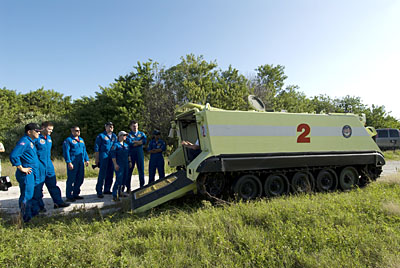
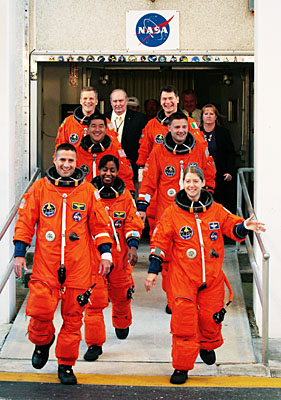
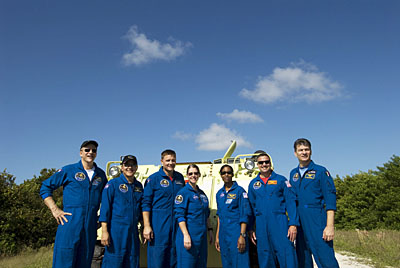
STS-120 during M-113 training at KSC
The STS-120 crew during training with the M-113 armoured personel carrier at KSC

11 October 2007
ESA astronaut Paolo Nespoli and his fellow STS-120 crewmembers have taken part in a practice countdown at NASA's Kennedy Space Center, in Florida, ahead of their mission to the International Space Station due for launch later this month.

The practice countdown, or Terminal Countdown Demonstration Test (TCDT), is considered a key training exercise for the astronauts and for the Kennedy Space Center (KSC) launch team. The exercise gives engineers an opportunity to run through the preparations leading up to a Shuttle launch. It also serves as a launch-day dress rehearsal for the astronauts.

As part of the training at KSC the crew are familiarised with the M-113 armoured personel carrier which is used to evacuate the crew from the launch pad in the case of fire. Later in the TCDT the crew donned their orange partial-pressure suits and entered Space Shuttle Discovery for a simulation of the launch countdown.

As well as exchanging a member of the Station's permanent crew, and the challenging operation of repositioning a set of solar arrays, the STS-120 crew is responsible for the safe delivery of the Italian-built Node 2 connecting module - an important step in the continued construction of the International Space Station.

The arrival of the cylindrical Node 2 module, which will be attached to the end of US Destiny laboratory, paves the way for the addition of the European Columbus laboratory and the Japanese Kibo laboratory.

STS-120 is scheduled for launch on 23 October 2007.


STS-120 during M-113 training at KSC
The STS-120 crew during training with the M-113 armoured personel carrier at KSC


Nespoli drives M-113 vehicle
ESA astronaut Paolo Nespoli drives M-113 armoured personel carrier at KSC


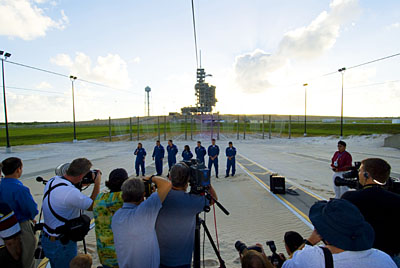
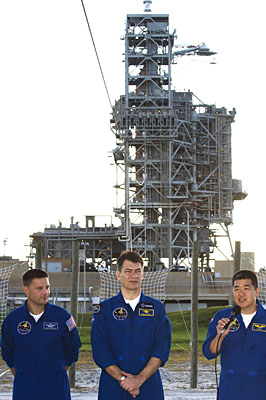
STS-120 during press Q&A at KSC
STS-120 crew answers press questions during the Terminal Countdown Demonstration Test at NASA's Kennedy Space Center, Florida


STS-120 meet the press during TCDT at KSC
STS-120 crew meet members of the press during Terminal Countdown Demonstration Test at KSC


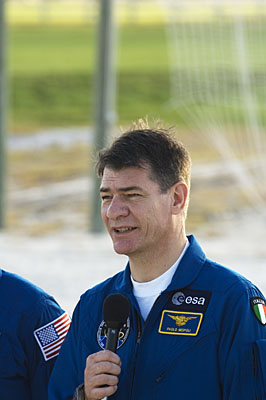
Nespoli during TCDT press Q&A
ESA astronaut Paolo Nespoli answers press questions during Terminal Countdown Demonstration Test at KSC


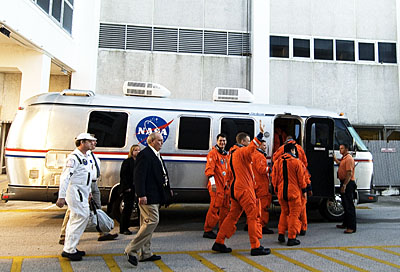
STS-120 crew board bus to launch pad
The STS-120 crew walks out to board a bus that will transport them to the launch pad for a simulated countdown


Nespoli during countdown simulation at KSC
ESA astronaut Paolo Nespoli during the practice countdown for Space Shuttle flight STS-120


STS-120 crew board bus to launch pad
The STS-120 crew boards a bus that will transport them to the launch pad

ESA : Navigation application projects to identify GNSS evolutions - Open invitation for outline tenders

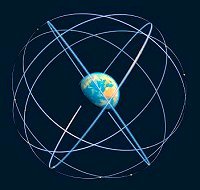
Galileo orbits


11 October 2007
In the frame of the European Global Navigation Satellite System Evolution Programme, ESA is launching a call for ideas for advanced radio navigation applications concepts.

ESA is currently initiating system studies aiming at defining the directions that should be taken for the evolution of the European Global Navigation Satellite Systems (GNSS): Galileo as the global component and EGNOS as its regional component. These directions include improved performance, new characteristics (for example, new signals) and new functionality.

This 'top-down' approach is being complemented with a 'bottom-up' approach intended to identify advanced applications concepts that may drive the GNSS evolution process. Such an approach will help match the system evolution with market needs and further boost the development of navigation applications based on GNSS.

The purpose of this open call is to stimulate the development of new ideas for these advanced applications. Interested parties are invited to submit innovative ideas or applications that would require enhanced performance or functionality from the GNSS.

Submissions may be either extensions of already well-identified applications or completely novel applications made possible by novel features (for example, C-band navigation signals). It is envisaged that a successful application project design in the frame of this study could lead to a subsequent pilot project in further steps of the programme.

The online application form is available here. The deadline for submission of proposals is 20 November.

The formal Invitation Io Tender (ITT) is available on ESA's EMITS system.

ESA New isotope molecule may add to Venus’ greenhouse effect

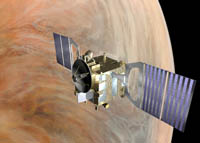
Artist's impression of Venus Express orbiting Venus
Venus Express


10 October 2007
Planetary scientists on both sides of the Atlantic have tracked down a rare molecule in the atmospheres of both Mars and Venus. The molecule, an exotic form of carbon dioxide, could affect the way the greenhouse mechanism works on Venus.

The discovery is being announced today at the annual meeting of the American Astronomical Society’s Division of Planetary Sciences in Orlando, Florida. Its presence could affect the way the greenhouse mechanism works on Venus.

The mystery began back in April 2006, soon after ESA’s Venus Express arrived at the second planet in the Solar System.

A European team including members from France, Belgium and Russia lead by Jean-Loup Bertaux, Service d'Aeronomie du CNRS, France and Ann-Carine Vandaele, Institut d'Aeronomie Spatiale de Belgique, were using their Infrared Atmospheric Spectrometer (SOIR) instrument to measure solar occultations.

To do this, the instrument watches the Sun set behind Venus, allowing the scientists to study the way specific wavelengths of light are absorbed by the planet’s atmosphere. These wavelengths and the level of absorption then give away the identity and amount of gases in the atmosphere.

The team saw an unidentified signature at 3.3 micrometres in the mid-infrared region of the spectrum. “It was conspicuous and systematic, increasing with depth in the atmosphere during the occultation, so we knew it was real,” says Bertaux.


Stellar occultation technique used at Venus
The team kept their discovery confidential as they attempted to identify the molecule responsible. They thought at first that it must be an organic molecule. These molecules contain carbon and hydrogen. However, none of the known organic molecules fitted well with the observations.

Then, in December 2006, Mike Mumma of NASA’s Goddard Space Flight Center, Maryland, enquired whether the SOIR team was seeing anything special on Venus at 3.3 microns. He had discovered an unidentified spectral signature at that wavelength using telescopes on Hawaii pointing at Mars. The two teams compared the absorption signatures: they were identical.

This was a big clue. Both the atmospheres of Mars and Venus are composed of 95% carbon dioxide, although Venus’s atmosphere is much thicker than the one at Mars. The American team suggested that the signature could be coming from an isotope of carbon dioxide, where one oxygen atom is ‘normal’, with eight protons and eight neutrons, while the other has eight protons and ten neutrons. Such an isotope makes up about 1% of carbon dioxide on Earth, the rest contains two normal oxygen atoms.

However, no one had previously seen the molecule absorb at 3.3 micrometres. An investigation by three independent groups, one led by Mumma in America, Sergei Tashkun and Valery Perevalov at Tomsk State University, Russia, and Richard Dahoo at Service d'AƩronomie du CNRS, France, all came to the same conclusion. The signature could be caused by a rare transition only possible in the isotope.

The different weights of the oxygen atoms allow the molecule to alter its vibration in two ways simultaneously, whereas normal molecules can only change one state at a time.

This rare transition allows it to absorb even more energy and so contribute even more to the greenhouse effect on Venus. On Earth, however, there is 250 000 times less carbon dioxide so its additional contribution to our greenhouse effect will be small.


Notes for Editors:

The findings appear in: ‘First Observation of 628 CO2 isotopologue band at 3.3 micrometres in the atmosphere of Venus by solar occultation from Venus Express’ by J-L Bertaux, A. C. Vandaele, V. Wilquet, F. Montmessin, R. Dahoo, E. Villard, O. Korablev, A. Fedorova.

Universe Today : High Resolution Views of Potential Mars Landing Sites

Written by Fraser Cain
Candor Chasma region on Mars. Image credit: NASA/JPL/HiRISE
Mission planners for the Mars Science Laboratory have quite a challenge on their hands. Where should they land the rover in 2010? They've got a whole planet to choose from. Well, they've narrowed the field of prospective landing sites down to about 30 intriguing candidates. And now NASA's Mars Reconnaissance Orbiter has delivered high resolution images of each and every potential landing site… in colour!

We've got Spirit and Opportunity currently crawling across the surface of Mars. The Phoenix Mars Lander is on its way now. But when NASA's Mars Science Laboratory arrives in 2010, the science is really going to get rolling. This SUV-sized robotic explorer will bring its own nuclear power source, and a suite of science instruments, giving it the range and capabilities to find life on the surface of the Red Planet.

But where should it land? The University of Arizona's HiRISE team delivered 143 images captured by NASA's Mars Reconnaissance Orbiter to the researchers this week, showcasing each location in false and enhanced colour.

Normally the spacecraft captures its images in black-and-white. It's relatively simple to grab a single image of the Martian surface with one of its filters. When you're trying to get colour, though, things become more complicated. The spacecraft moves so quickly above Mars that it's very difficult to capture several images of the same area in different wavelengths of light and then merge them together into a single colour image.

Researchers with the HiRISE team have developed a computer program that can process data from different colour filters and merge them into a single image. Of course, to process each 20,000 by 50,000 pixel region can take several hours.

Mission planners for the Mars Science Laboratory will be meeting at a workshop later this month to try and narrow down the field of choices. These colour photographs will help them make a decision.

You can browse all the images yourself if you like. Click here to see them. You can also access the movie that pans across a potential landing site at Nili Fossae. The animation shows a range of enhanced colours that reveal rocks that might have been altered by water in the past.

Original Source: UA News Release

Universe Today : Expedition 16 is Off to the International Space Station

Written by Fraser Cain

Launch of Expedition 16. Image credit: NASA
The next inhabitants of the International Space Station, Expedition 16, were blasted into orbit today aboard a Russian Soyuz rocket. On board are Malaysia's first astronaut, Sheikh Muszaphar Shukor, veteran cosmonaut Yuri Malenchenko, and US commander Peggy Whitson - the first woman to ever command the station.

The Soyuz TMA-11 spacecraft blasted off from the Baikonur Cosmodrome in Kazakhstan today at 1322 UTC (9:22 a.m. EDT). It should take another two days for them to match orbits with the International Space Station; the docking is planned for Friday at 1452 UTC (10:52 a.m. EDT).

Once they do arrive at the station, they'll begin the process of taking over responsibilities from Expedition 15. During their 6-month mission on the station, they'll be busy to say the least. Three space shuttles are due to dock and continue construction of the station, and Europe's first automated cargo ship, Jules Verne, will also visit during their mission.

Two members of Expedition 15, commander Fyodor Yurchikhin and flight engineer Oleg Kotov, will return to Earth with Malaysia's Shukor on October 21st. NASA astronaut Clayton Anderson will remain onboard for the first stage of Expedition 16.

Original Source: NASA News Release

Universe Today : First Pictures From Kaguya

Written by Fraser Cain

The moon, captured by Kaguya
The Japanese space agency JAXA has confirmed that their lunar orbiter Kaguya (aka Selene) is now firmly in orbit around the Moon. That was quick. The agency released this image captured by Kaguya's high-gain antenna motor camera showing its new home.

The spacecraft isn't due to take photographs with its full suite of scientific instruments until it reaches its final science orbit later this month. This image was captured by the antenna motor, which just happens to have a view of the Moon in the background. Don't worry, the images are going to get much, much better.

By the time Kaguya is in its final science orbit, it will be able to capture images of the lunar surface at a resolution of 1-metre. It will also be recording high-definition television images of the surface, which should look just amazing in the eventual documentaries.

Original Source: JAXA News Release

Universe Today : The Tiger Stripes and Geysers are Linked on Enceladus

Written by Nicholos Wethington

Tiger stripes on Enceladus. Image credit: NASA/JPL/SSI
Saturn's moon Enceladus is one of the most peculiar objects in the Solar System. We now know there are geysers of water ice blasting from its southern pole; a place marked with long gashes that researchers have dubbed "tiger stripes". Ever since the geysers were first discovered, scientists have been puzzling out their source. Now they understand how the geysers and tiger stripes are linked.

New research by the Cassini imaging team, CICLOPS, shows that the jets of Enceladus emanate from its southern pole, pouring out of four of the tiger stripes. The researchers have named them Alexandria, Cairo, Baghdad and Damascus. Of the four, Baghdad and Damascus are the most active and Alexandria is the least.

By taking Cassini's two-year observations of the jets that spray from the surface, and combining this with thermal imaging of the stripes, the team was able to determine that the jets were spraying vertically out of the stripes, which are cracks on the surface of Enceladus.

The water sprays through the cracks because the gravity of Saturn pulls and pushes on Enceladus, and this motion - called a tidal force - heats up the frozen water underneath the surface. Much like geysers on Earth, the water is heated and expands below the surface, and follows the easiest path it can find to escape; this path happens to be right through the tiger stripes on the surface.

The researchers noted that when the tidal pull of Saturn was compressing this region of Enceladus, the geysers were not very active, if at all. But when the tides pulled and created tension, they began to erupt. Also, the hotter the region was, the stronger and larger the jet plume tended to be.

There may be other areas of Enceladus capable of producing jets, and now that the origins of the geysers are confirmed, more thermal and digital imaging of the surface could reveal other geysers in the future.

The researcher paper, entitled "Association of the jets of Enceladus with the warmest regions on its south-polar fractures" was published in the October 11th edition of the journal Nature.

Source: Nature

Universe Today : New Horizons Makes Surprising Discoveries at Jupiter

Written by Fraser Cain

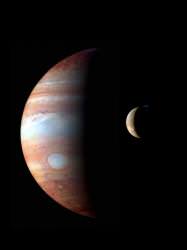
Montage of New Horizons images of Jupiter and Io. Image credit: NASA/JPL/JHUAPL
Remember when New Horizons sped past Jupiter on its way to Pluto. It kept its cameras rolling during the flyby, and captured hard drives full of data. Researchers have had a chance crunch through some of this data, and announced a series of discoveries this week: polar lightning storms, clumpy rings, volcanic eruptions on Io, and more.

New Horizon's goal may be Pluto, but it's got some time to kill between now and then. Might as well gather some science along the way. The spacecraft sped past Jupiter on February 28, 2007, picking up a valuable gravity assisted speed boost. It was the 8th spacecraft to make a close encounter with Jupiter, and just those before, it revealed valuable new insights into Jupiter and its satellites.

When the spacecraft was approaching Jupiter, mission planners carefully planned out 700 observations they wanted New Horizons to make. In fact, this is twice the number planned for the brief flyby of Pluto in 2015. They focused their collection on outstanding scientific issues that needed further investigation; to try and give scientists some kind of closure to mysteries opened up by previous spacecraft flybys.

Top on the list is Jupiter's weather. New Horizons observed the planet's clouds using visible light, infrared and ultraviolet. They saw ammonia clouds welling up from deeper down and heat-induced lightning strikes in the polar regions - the first polar lightning seen apart from Earth.

The spacecraft also focused in on Jupiter's tenuous rings. The detailed observations revealed clumps of material that could indicate there was a recent impact inside the rings. Just like Saturn, Jupiter has tiny moons that serve as shepherds, keeping the ring material together.

New Horizons also focused its cameras on Jupiter's volcanic moon Io. The spacecraft observed 11 different volcanic plumes of varying size, and could see 36 hotspots on the moon in the infrared spectrum. Three of these volcanoes were seen for the very first time.

Finally, the spacecraft measured the magnetic tail that trails behind Jupiter. New Horizons saw material ejected by Io moving down the tail in large, dense, slow-moving blobs, captured in the magnetic field.

New Horizons is now halfway between the orbits of Jupiter and Saturn, and more than 1.19 billion km (743 million miles) from Earth.

Original Source: JHU APL News Release
Universe Today : Are We Made of Quasarstuff Too?

Written by Fraser Cain

Artist illustration of dust from a black hole. Credit: NASA/JPL-Caltech/T. Pyle (SSC)
Carl Sagan noted that we're all made of starstuff; the elements fused together in stars and detonating supernovae. But maybe we're made of something else too, outflowing dust from actively feeding supermassive black holes - known as quasars - that populated the early Universe. New observations made by NASA's Spitzer Space Telescope has found evidence of dust pouring out of distant quasars. Dust that might have gone on to form more complex molecules, and even life. We're all made of quasarstuff?

Our Sun formed in a region of the Milky Way enriched by the deaths of massive stars. As these monsters detonated as supernovae, they created the heavier elements and spread them far and wide around the region. But what about the early Universe, before generations of massive stars had a chance to live and then die as supernovae? Where did all the raw materials come from?

Researchers from the University of Manchester in the U.K. have written a new research article describing how they have discovered dust pouring out of supermassive black holes in the early Universe. Known as quasars, and bright enough to be seen clear across the Universe, these actively feeding black holes are actually quite messy. They eject more material out in polar jets than they're actually able to consume.

And according to Spitzer, the material they're ejecting contains plenty of complex dust. In one example, a quasar 8 billion light-years away is spewing out a mix of ingredients that make up glass, sand, marble and even precious gems like rubies and sapphires.

This is quite surprising, since the main ingredient of sand, crystalline silicate, can't last long in space. The radiation from stars should be blasting the molecules back to a glass-like state. If there's crystalline silicate, there must be a source replenishing it faster than the radiation can break it down. That source seems to be quasars.

It now appears that both supernovae and quasars work together to seed galaxies with heavier elements and complex molecules. So, we might not only be starstuff, we could also be quasarstuff.

Original Source: NASA/JPL/Spitzer News Release

Universe Today : Undergrad Team Discovers 1,300 Asteroids


Written by Fraser Cain

Asteroid Itokawa. Image credit: JAXA
A team of undergrad astronomers at the University of Washington figured out how to turn an annoyance into a major discovery, uncovering 1,300 new asteroids; nearly 1 out of every 250 known objects in the Solar System. How did they pull of this feat? It was actually a side project to their actual research: searching for supernovae. The asteroids were getting in the way.

The undergrad researchers were looking through data gathered as part of the Sloan Digital Sky Survey. This is a collection of detailed images of the sky gathered by an automated 2.5-metre telescope. The researchers were looking for evidence of exploded stars, called supernovae, but asteroids kept getting in the way.

Instead of just working around the asteroids that were blocking their view, they decided to keep track of them, and see if any were unidentified. It turned out that 1,300 were brand new.

Andrew Becker, a UW research assistant professor in astronomy explains the initial frustrations, "I kept asking the students what they had found and they kept saying, 'More asteroids. No supernovae, but lots of asteroids.'"

The undergrads developed programs that let them search through the Sloan data automatically, identifying asteroids, and helping them classify them. In addition to discovering 1,300 new asteroids, they compiled additional data on 14,000 asteroids that were already known. This allows astronomers to calculate their trajectories with better accuracy, and determine if any are a threat to the Earth in the future.

Original Source: UW News Release