Google
 

Wednesday, December 19, 2007

Universe Today : Enceladus: Cold Moon With a Hot Spot


Written by Nancy Atkinson
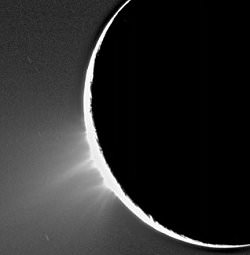
Plumes on Enceladus.  Image Credit:  NASA/JPL/Cassini team
Saturn’s tiny moon Enceladus is a cold and icy place. But somehow, there’s enough heat being generated on Enceladus’ south pole to eject plumes of ice and vapor high above the moon. These plumes are extremely intriguing to the Cassini mission scientists and they want to know more about this hot spot on a very cold moon. In fact, Enceladus has become a major priority for study by the Cassini team and they are anticipating learning more about the moon in an upcoming fly-by.

The temperature at Enceladus' south pole is about -220 degrees Celsius, but the hot spot is at least 100 degrees warmer. The leading model for the cause of the plumes on Enceladus is that the moon’s tides cause its crust to ratchet, or rub back and forth, in a set of faults near the south pole. The forces between Enceladus, the big planet Saturn and another moon, Dione cause what’s called dynamical resonance, and Enceladus is continually squeezed under this gravity field. This process creates a small hot spot, in relative terms, for an icy satellite.

Cassini has actually flown through the plumes, giving scientists a glimpse of the plume’s make up.

“The plume particles are like smoke, ice smoke, “said William B. McKinnon, professor of earth and planetary sciences at Washington University in St. Louis. “If you were standing on Enceladus’ surface you wouldn’t even be able to see the plumes. The particles are just larger than the wavelength of light, about one-thousandths of a millimeter. Most icy bodies of this size are geologically inert, but this is a clear indication of geological activity. Cassini has found active venting of water vapor. This leads to scientifically intriguing speculations and questions.”

The scientists are pondering if Enceladus has active ice volcanism, and if so, is it due to ice sublimating, like a comet, or due to a different mechanism, like boiling water as in Old Faithful at Yellowstone. Even though there may be water on the moon, McKinnon doesn’t believe there is the possibility of life on Enceladus. This is because measurements made from Earth don’t indicate there is enough sodium present in the plumes to warrant the “life” question. “The emerging view is that there’s not obvious evidence for a subterranean ocean in contact with rock, no boiling or venting,” said McKinnon.

The Cassini science team has made Enceladus a major priority and there will be seven additional close fly-bys of the moon by the spacecraft through mid-2010 (provided the mission is extended to that period.) The next fly-by will be on March 8, 2008 and Cassini will approach Enceladus at an incredibly close 25 km in altitude at the low latitudes and fly over the south pole at 580 km altitude. The spacecraft will actually fly through the plumes and should be able to take high-phase images of the plumes, map the temperatures of that region, search for any activity at other latitudes as well as image other interesting features on Enceladus, such as “tiger-stripe” –like fissures found near the south pole.

“We still can’t say how truly ‘hot’ the hot spots are,” said McKinnon. “We’ll probably learn this in March.”

Original News Source: Washington University Press Release

Universe Today : Mars at its Closest Approach


Written by Fraser Cain

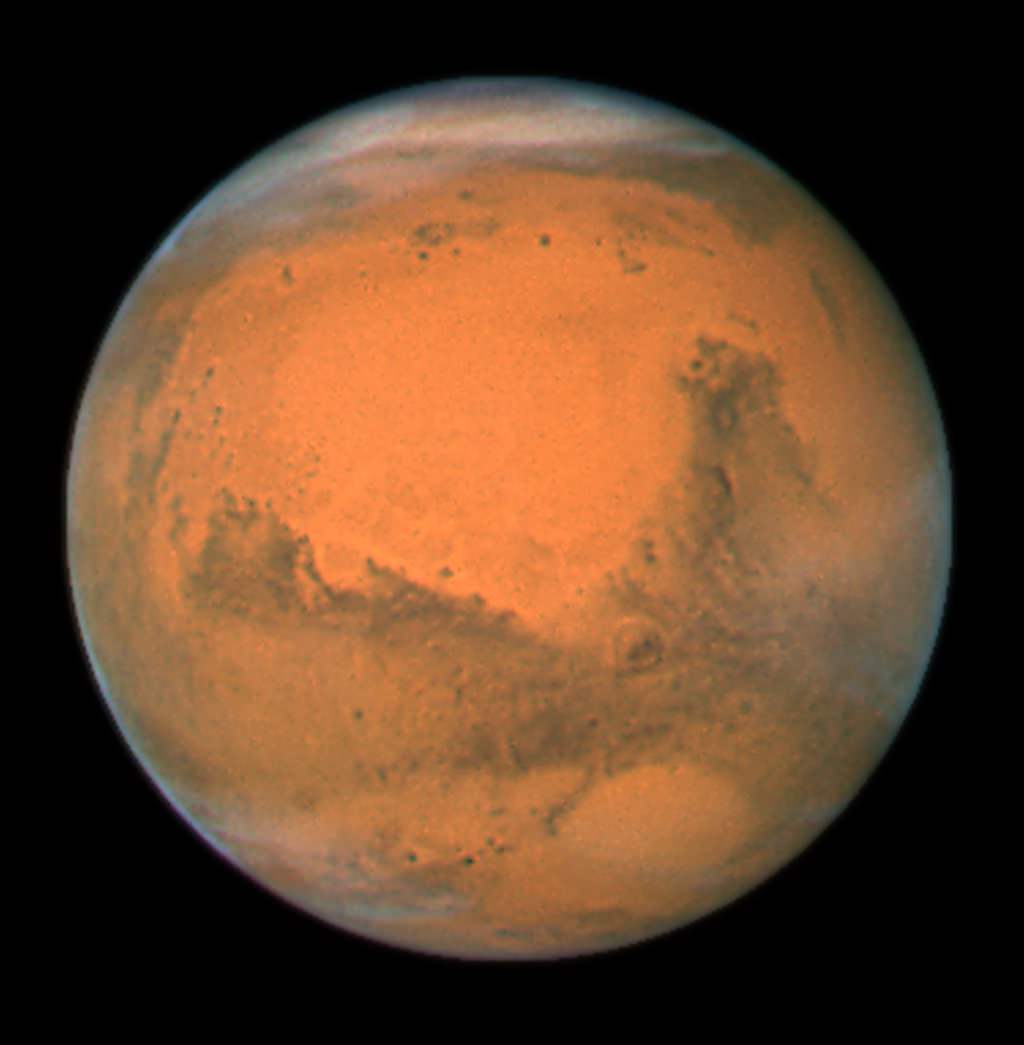
Mars. Image credit: Hubble Space Telescope
Okay, now you can tell your friends and family that Mars is making its closest approach, and not August like that annual hoax email that goes around. This image of Mars, taken by the Hubble Space Telescope, was captured when the planet was only 88 million km (55 million miles) away from Earth. Their closest point occurs on December 18th at 1145 UTC (6:45 p.m. EST).

This close encounter between the Earth and Mars happens every 26 months. That's because Earth makes more than two orbits for every one Martian trip around the Sun. As the Earth catches up with Mars in orbit, the planet brightens in our skies until it becomes one of the brightest objects we can see.

Since both Earth and Mars have elliptical orbits, the point of their closest approach changes from year to year. Back in 2003, when that closest approach between Earth and Mars actually happened, the two planets were 32 million km closer (20 million miles) than today. (Of course, Mars never looked as large as the Moon in the sky, it was always just a bright red star.)

The image attached to this story was made up of a series of photographs captured by Hubble over the last 36 hours. They were then stitched together on computer to make up this composite photograph.

The large triangular dark shape on Mars is Syrtis Major, and the region on the left is called Sinus Meridani. That's roughly where NASA's Opportunity rover is currently rolling across the Martian landscape.

When Hubble took this photograph, the planet was largely free of the dust storms that plagued the Mars rovers earlier this year. Although, you can see clouds near the northern and southern poles.

Original Source: Hubble News Release

Universe Today : Mysterious Explosion Comes Out of Nowhere


Written by Fraser Cain

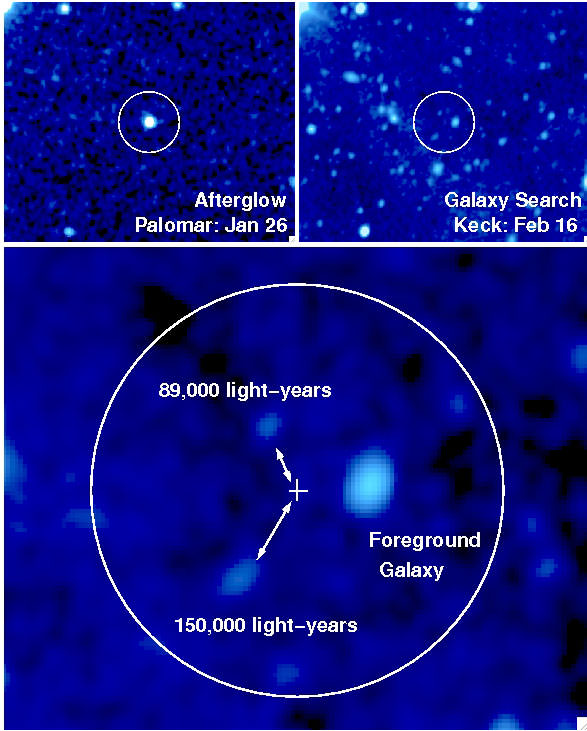
Mysterious gamma-ray burst. Image credit: NASA
When astronomers find a gamma ray burst, they can usually locate the culprit's home galaxy. But in the case of an explosion that went off earlier this year, there's no galaxy to be found - even with the most powerful telescopes on Earth.

The gamma ray burst GRB 070125 was first detected on January 26th, 2007 by NASA's Swift telescope in the constellation Gemini. One of the brightest bursts of the year, astronomers scrambled to observe the explosion and then the slowly fading afterglow.

Gamma ray bursts occur when a massive star runs out of fuel. Without the light pressure, the star collapses inward on itself, turning into a black hole. This newly formed black hole spins at an enormous rate, generating enormous magnetic fields. These fields catch infalling material and spew it out again into powerful jets. And it's those jets where the burst comes from.

One of the normal activities in observing GRBs is the identify the host galaxy so that astronomers can measure its distance. It's also important to know what kind of galaxy the burst exploded within to better understand the kinds of environments can lead to these massive stars.

In the case of GRB 070125, though, no originating galaxy was obvious. Astronomers from Caltech/Penn State used the 60-inch Palomar Observatory to watch the afterglow, and then called in the even larger Gemini North and Keck 1 telescopes, located on Hawaii's Mauna Kea.

Even with the power of Keck, they couldn't find a galaxy.

So how could you get a gamma ray burst without a galaxy? Astronomers know that colliding galaxies can throw off enormous tidal tails that stretch away for hundreds of thousands of light-years. The original star could have been within one of these tidal tails, many light-years away from its parent galaxy.

If their theory is correct, a long duration exposure from the Hubble Space Telescope should reveal the dim tidal tail.

Original Source: NASA News Release

Space.com : Spacewalkers Inspect Space Station's Solar Wing Joints


By Tariq Malik
Staff Writer
posted: 18 December 2007
12:51 p.m. ET

This story was updated at 3:00 p.m. EST.

Two spacewalking astronauts took a close look at a pair of balky solar array joints outside the International Space Station (ISS) Tuesday to help engineers on Earth draw up repair plans.

Expedition 16 commander Peggy Whitson and flight engineer Dan Tani found widespread contamination inside a massive gear that rotates both of the station's starboard solar arrays, but no sign of damage to a joint at the base of one of those solar wings, during nearly seven hours of orbital work.

"Hopefully we got a good amount of data for the folks on the ground," said Tani, who led the spacewalk, after the reentering station's Quest airlock.

Whitson and Tani began Tuesday's spacewalk at 4:50 a.m. EST (0950 GMT), marking the fourth for their Expedition 16 mission. The excursion was initially scheduled as an extra spacewalk during NASA's STS-122 mission aboard the shuttle Atlantis, but the flight's planned December launch was thwarted twice by faulty fuel tank sensors.

As the Expedition 16 crew worked in orbit high above Earth, engineers at NASA's Kennedy Space Center in Florida fueled Atlantis' external tank to test the erratic sensors. Shuttle workers hoped to recreate, and then isolate, persistent glitches with the fuel gauge-like sensors in order to proceed with Atlantis' rescheduled Jan. 10 launch.

Fact-finding inspection

Whitson and Tani focused most of their spacewalk on a massive gear designed to rotate the station's starboard solar arrays like a paddlewheel to keep its power-generating wings continuously facing the sun.

Engineers will use the astronauts' findings as a reference for any plans to repair the joint's bearings, motors and metal race ring. Solving the station's solar array joint woes is vital to allow the outpost to support the addition of a large Japanese-built laboratory and other modules, mission managers have said.

"We didn't find anything that stood out," said NASA's space station program manager Mike Suffredini after the spacewalk. "It would be really nice if something stood out and said, 'Hey, I'm the cause of your problem,' and we didn't get that. But we do know more about the condition of the ring."

Tani first discovered metal grit inside the joint, known as a Solar Alpha Rotary Joint (SARJ), during a late October spacewalk after flight controllers noticed odd vibrations and power spikes in the mechanism's telemetry. A second inspection by spacewalkers last month confirmed the contamination, which Tani and Whitson found to be widely distributed around the 10-foot (3-meter) wide joint during today's excursion.

"You can see the motion of the gear because the debris is kind of walking across the housing," said Tani, adding that magnetized metal shavings appeared to walk end-over-end on one of the SARJ motors. "It's hilarious...it's animated, like they're alive. They're like ants."

The spacewalkers retrieved a suspect set of bearings, one of 12 on the joint, which may be responsible for the contamination. They also used orange Kapton tape to take samples of the metal grit and clean the SARJ gear's damaged metal race ring.

"I am getting almost all of the debris off," Whitson said. "It seems less splotchy."

Using a mirror, Tani and Whitson looked inside the SARJ gear to find that two sides of its three-sided race ring were untouched by damage, boosting hopes that engineers can find a way to continue using the joint in short spurts while continuing to study the glitch.

"If we can figure out to live with this, maybe roll on it for awhile when we have to...it gives us more time to figure out root cause and figure out what the real issue is," Suffredini said. By taking that extra time, engineers could determine whether a major switch to a backup race ring, which could potentially take up to four spacewalks and be performed during a fall 2008 space station mission, will be required, he added.

Tuesday's spacewalk marked the 100th outside the ISS and the 23rd this year alone, tying the all-time record for excursions in a single year. The spacewalk was the fifth career outing for both Tani and Whitson, who set a new world record during the outing for the most spacewalking time for a female astronaut.

"Congratulations, there is no pressure now because you are the queen of EVA," Mission Control told Whitson, using NASA's abbreviation for extravehicular activities.

"It's just being in the right place at the right time," replied Whitson, who is the space station's first female commander and beat NASA astronaut Sunita Williams' benchmark of 29 hours and 17 minutes to nab the title.

Hunting for damage

In addition to their SARJ joint inspection, the spacewalkers also surveyed cables and other hardware for a beta gimbal joint that swivels one of the station's starboard solar wings on a different axis from the SARJ. The joint suffered triple electrical failures on Dec. 8, prompting concerns on Earth of a possible micrometeorite strike.

"Everything I can see is nominal," Tani said. "There is no damage, no frays that I can see."

Despite her bulky NASA spacesuit, Whitson squeezed herself inside the station's backbone-like truss to reach the gimbal joint's power cables. Mission controllers warned her that it would be a tight fit, prompting a laugh from the spacewalker.

"Does this [spacesuit] make me look fat," she joked.

Space station managers said they are now confident that the gimbal joint's glitch lies in its motor box. A spare for the unit is aboard the ISS and Tani is trained to replace the motor.

Whitson ended Tuesday's spacewalk with 32 hours and 36 minutes of spacewalking time under her belt across five career excursions. Tani, meanwhile, ended with 32 hours and one minute as he concluded his fifth career spacewalk.

Tuesday, December 11, 2007

Space.com : Missing Matter Caught in Tangled Cosmic Webs


By SPACE.com Staff

posted: 10 December 2007
06:33 am ET

Cosmologists are always complaining about their inability to find the dark matter in the universe, invisible stuff that's supposedly more prevalent than regular matter. They don't even know what it is, so of course they can't see it.

Meantime, a whole bunch of normal matter is missing, too.

A new computer model at least suggests where some of that missing normal matter might be.

Regular vs. dark

Regular matter—the "visible" atoms and molecules of dirt, people, stars, gas and dust—makes up only about 5 percent of the universe. Scientists call it baryonic matter, or baryons.

Dark matter is the term used to describe the invisible stuff that's holding galaxies together. Some 25 percent of the universe is dark matter, and it's all missing in action. The rest is even more mysterious, a sort of anti-gravity force called dark energy.

While scientists have no clue when they'll actually find dark matter, they'd really like to square the cosmic ledger a bit by tallying up all the regular matter that theory holds should exist. Only about 40 percent of it is in the books yet.

The rest, according to the new simulation, is gas that's caught in a tangled web of cosmic filaments that are hundreds of millions of light-years long. The filaments connect clusters of galaxies, and the gas within the filaments is hidden by huge gas clouds.

This conclusion is based on a new computer model that took nearly 10 years to make. It models a region of space equal to 2.5 percent of the visible universe and showed how matter collapsed due to gravity and became dense enough to form the cosmic filaments, galaxy structures and the clouds that hide the filaments.

"We see this as a real breakthrough in terms of technology and in scientific advancement," said Jack Burns of the University of Colorado at Boulder. "We believe this effort brings us a significant step closer to understanding the fundamental constituents of the universe."

The research will be detailed in the Dec. 10 issue of the Astrophysical Journal.

Let's look

Burns predicts that future telescopes will be able to spot the filaments.

The 10-meter South Pole Telescope in Antarctica and the 25-meter Cornell-Caltech Atacama Telescope, or CCAT, being built in Chile's Atacama Desert, will aim to do so, Burns said.

The CCAT telescope will observe radiation in sub-millimeter wavelengths, which are longer than infrared waves but shorter than radio waves. It will probe galaxies in their infancy shortly after the universe was born.

"We think that as we begin to see these filaments and understand their nature, we will learn more about the missing baryons in the universe," Burns said.

HubbleSite : Hubble Finds that Extrasolar Planet Has a Hazy Sunset

A team of astronomers, led by Frederic Pont from the Geneva University Observatory in Switzerland, has detected for the first time strong evidence of hazes in the atmosphere of a planet orbiting a distant star. The new Hubble Space Telescope observations were made as the extrasolar planet, dubbed HD 189733b, passed in front of its parent star in an eclipse. As the light from the star briefly passes through the exoplanet's atmosphere, the gases in the atmosphere stamp their unique spectral fingerprints on the starlight. Where the scientists had expected to see the fingerprints of sodium and potassium, there were none; implying that high-level hazes (with an altitude of nearly 2,000 miles) are responsible for blocking the light from these elements.

Universe Today : Water or Land: The Orion Landing Choice

Written by Nancy Atkinson

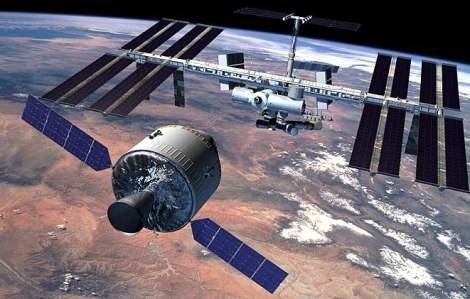
ISS and CEV.  Image Credit:  NASA
Work is progressing on designing the new Orion Crew Exploration Vehicle (CEV), the next generation of NASA spacecraft that will take humans to the International Space Station, back to the Moon, and hopefully on to Mars. But one major question about the spacecraft has yet to be answered. On returning to Earth, will the CEV splash down in water, or land on terra firma?

NASA officials discussed various aspects of development that is currently underway for the Constellation program at a media briefing on December 10. The mobile launch platform for the Ares rocket is being built, landing parachutes have been tested and the first capsule structure of the new CEV will be constructed starting in early 2008. Design requirements for the booster rockets have been completed and just ahead are final design definitions for operational capabilities such as ground procedures at Kennedy Space Center, mission control in Houston and other areas such as spacesuit design.

Additionally research on the International Space Station has begun to help prepare for long duration spaceflights such as a measurements of microbe growth, a study of the formation of kidney stones, and a nutritional study to help understand what is ‘normal’ for the human body in space.

But questions from the media focused mainly on the yet unmade decision of whether the CEV will land in the water or on land.

NASA originally explored multiple options for landing in both water and land. After initial studies, the first assessment by NASA and the contractor for the CEV, Lockheed Martin, was that landing on land was preferred in terms of total life cycle costs for the vehicles. But now a splashdown in water seems to be favored.

“There are a couple of aspects that pop out at us,” said Jeff Hanley, Manager for the Constellation Program. “One is the safety and the risks involved in landing. Looking at the landing itself, the event of actually touching down, water comes out to be preferable as less risk.” Another aspect is the performance of the Orion vehicle as it is sent to the moon. “In looking at what it takes to get a pound of spacecraft to low lunar orbit in terms of the cost, every pound that you send toward the moon is precious. From an efficiency and performance point of view, carrying 1500 lbs of landing bags to the moon and back when we have a perfectly viable mode of landing in the water near a US coastal site didn’t seem like a good trade in performance. We’ve tended toward updating our point of departure concept to now be a nominal US coastal water landing.”

The Constellation program has always considered that for the first few missions, the spacecraft would land in water until the guidance system had been tested thoroughly and proven in actual landings.

But NASA is continuing to look at landing on land as a possibility for future flights. “We want to be able to land on land in a contingency and have the crew be able to get out and walk away….There’s limitation of what you can do on land but by the time we get done really looking at what the minimal capability of landing on land and having the crew walk away, we’ll see what the design looks like, and if the design is robust enough we could return to having nominal land landings.”

One challenge for the Constellation program has been getting the CEV light enough for the Ares rockets to be able to launch it, and therefore eliminating the 1500 lb airbags for landing has its appeal.

“The predominant design philosophy for Orion and Ares 1 has been that we are designing for lunar missions,” continued Hanley. “We will service the International Space Station within that set of capabilities. From that perspective, designing a lot of mass into the spacecraft just to enable land landings has not traded out to be an effective use of our performance. That’s the major consideration in play. Right behind that are life cycle costs.”

Making the decision of land vs. water is the goal for 2008 for the Constellation program. “We’ve studied and have cost estimates for water landings against the infrastructure costs of having multiple landing sites on land and they are comparable,” said Hanley. Right now, NASA is looking at a single target landing zone off the coast of California with one or two recovery vessels.

But they are keeping their options open for a land landing. “If the Orion team is able to come in at the preliminary design review later this next year with a concept for be able to land on land that is fairly robust but not cost a lot of mass to have to hurl to the moon and back, then it becomes an operational decision,” said Hanley.

There’s been much debate about what type of landing would be best. “There’s been a lot of assumptions made that landing on land is going to be better, but there are lot of people in the technical community that do not buy into that,” said Hanley. “There’s been a lot of debate surrounding whether or not land landing truly is better from a life cycle cost perspective and there isn’t a lot of quantitative data to really pull from.”

Hanley feels there are assumptions being made but not a lot of substantive date to clarify what the right answer is. So the next steps are to get the spacecraft to a detailed preliminary design and really interrogate the water vs. land issue. That includes further developing the operational concepts , such as how long does the capsule stay in the water, and what loads does the spacecraft see from landing on water and land. Those are all questions that need to be answered in order to make a final decision on the type of landing that will be used. Stay tuned, as 2008 should be a year of decision for many details about Constellation and the CEV.

Original News Source: NASA News Audio

ESA : Mars Express watches a dust storm engulf Mars


A dust storm on Mars


11 December 2007
This summer, Mars suffered a titanic dust storm that engulfed the entire planet. The dust storm contributed to a temporary warming effect around Mars, which raised the temperature of the atmosphere by around 20-30°C.

However, the surface temperature of the planet itself dropped.

Imagine a dust cloud on Earth that started in the Sahara desert and grew to encompass our whole planet. Such a catastrophe would block sunlight from reaching the surface and plunge us into twilight for months. It happens on Mars on a regular basis. Planetary scientists watched the latest dust storm take shape at the end of June. By mid July it had covered the Red Planet, dispersing gradually over the next few months.

Whereas some of the spacecraft’s instruments, such as the Visible and Infrared Mineralogical Mapping Spectrometer (known as OMEGA) and the High Resolution Stereo Camera (HRSC), which both rely on a clear view of the surface have to wait until the dust subsides, the Planetary Fourier Spectrometer (PFS) instrument was able to work throughout the event and has gained new insights into the effects of the dust storms on the atmosphere of Mars.


Temperature in the Martian atmosphere

Temperatures in the Martian atmosphere
“Once the atmosphere becomes full of dust, only 20% of the solar radiation can reach the surface of the planet,” says Vittorio Formisano, Istituto Fisica Spazio Interplanetario, Rome, Italy, and the principal investigator of the PFS instrument.

The dust absorbs the solar radiation which directly heats the atmosphere, creating a strong warming effect. This year, PFS saw the temperature of the Martian atmosphere rise by between 20-30°C. As the atmosphere heats up, the atmosphere inflates around the planet. Formisano estimates that this increase was probably by about 20 km and hopes that a fuller analysis of the PFS data will give a precise figure.

PFS determines the composition of the Martian atmosphere from both the wavelengths of sunlight absorbed by the various molecules in the atmosphere and from the infrared radiation they absorb and emit. It collects infrared radiation in the range of 1.2–45 micrometres (microns).


Mars - thermal radiation spectra

There is still a lot to understand about Martian dust storms. They begin during summer in Mars’s southern hemisphere. Southern summer is hotter than the northern summer because Mars’s orbit is elliptical and draws the planet closer to the Sun during southern summer than during northern summer.

The Hellas Basin obviously plays a very important role as the dust storms usually begin in its vicinity. Hellas is a vast impact structure, 9 km deep and about 2300 km across. It is so large that it disrupts the circulation of the atmosphere. “How the dust propagates into the whole atmosphere is still a complete mystery,” says Formisano.

One puzzle is that the dust storms reach the poles of Mars. Polar regions on planets are usually distinct atmospheric pockets that prevent warm air from the equatorial regions from entering. On Mars, however, the dust reaches everywhere and smaller particles remain suspended for a long time. “The micron sized particles fall back to the surface in a few months, the sub-micron sized particle can remain up there for years,” says Formisano.


Mars Express artist's impression

Mars Express
“Another mystery is why such large dust storms happen some years and not others,” says Francois Forget, Université Paris, France, and Mars Express Interdisciplinary Scientist.

Interestingly, whereas the atmosphere of the planet heats up, the surface of the planet cools down because it receives much less solar heat. This poses an additional problem for Martian landers, which rely on solar arrays for power. They have to hibernate during the storms. It also presents a clear challenge to potential visiting astronauts.

“We have beautiful data from PFS of this dust storm and we now intend to analyse this fully,” says Formisano.

ESA : Envisat captures South Korea’s crude oil leak

Oil leak off South Korea

11 December 2007
Crude oil from the wrecked 146 000-ton tanker, Hebei Spirit, is seen polluting the sea off South Korea in this Envisat image.

More than 10 000 tons of oil from the tanker is reported to have leaked into the sea since colliding with another vessel on Friday 7 December. The South Korean government has declared the coastal regions, located southwest of Seoul, where oil is washing onto their beaches disaster areas.

This image was acquired today at 01:40 UTC by the Advanced Synthetic Aperture Radar (ASAR) aboard ESA’s Envisat, while operating in its wide-swath mode covering an area approximately 400 km by 400 km.

The presence of oil on the sea surface damps down smaller wind generated waves. It is these waves that reflect the radar signal back in the direction of the source. When they are damped, the reflected power measured by the radar is reduced, causing oil slicks to be seen as dark areas on an otherwise brighter sea.

ASAR, like other space-based radar systems, essentially provide its own source of illumination and operates at longer wavelengths than optical sensors. This enables it to observe the Earth’s surface at night and through thick cloud cover.

Monday, December 10, 2007

ESA : Columbus launch no earlier than 2 January

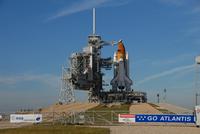
Atlantis on the launch pad
Atlantis ready on the launch pad

9 December 2007
The launch of the European Columbus laboratory on board Space Shuttle Atlantis' STS-122 mission to the International Space Station now is targeted to launch no earlier than 2 January 2008 from NASA's Kennedy Space Center. The liftoff date depends on the resolution of a problem in a fuel sensor system. For the latest updates, please consult the NASA website.

Early Sunday, one of the four engine cut-off, or ECO, sensors inside the liquid hydrogen section of Atlantis' external fuel tank gave a false reading while the tank was being filled. NASA's current Launch Commit Criteria require that all four sensors function properly.

The sensor system is one of several that protect the Shuttle's main engines by triggering their shut down if fuel runs unexpectedly low. Atlantis' scheduled launch on Thursday 6 December was delayed after two liquid hydrogen ECO sensors gave false readings.


Post-MMT briefing to announce the launch postponement

The main objective of Atlantis' 11-day mission is to install and activate the European Space Agency’s Columbus laboratory, which will provide scientists around the world the ability to conduct a variety of life, physical and materials science experiments.

In reaction to the postponement Alan Thirkettle, ESA’s ISS Programme Manager, was understanding of the situation. “We’re disappointed. We wanted to fly on Thursday and we wanted to fly today. But more importantly we want to fly safe,” he said. “The Space Shuttle is a complicated system which can have failures and can have stand downs – it is normal business.”

ESA officials will hold internal meetings this afternoon to discuss actions necessary to secure the Columbus laboratory and the Columbus payloads.