Google
 

Tuesday, January 8, 2008

Space.com : Our Universe: Dark and Messy

By Dave Mosher
Staff Writer
posted: 07 January 2008
06:55 am ET

Our universe is a mess — a colossal "cosmic web" of galaxies strung into filaments and tendrils that are millions or billions of light-years long.

Although this web's basic structure is resolved, astronomers say understanding it in more detail requires new observatories, better computing and a lot of luck.

"When you look into a large telescope, the reality of the cosmic web hits you in the face because you can see how galaxies are organized," said Rodrigo Ibata, an astronomer at the Observatoire Astronomique de Strasbourg in France. "We have clear evidence for the cosmic web's existence, but there is still so much we don't know about it."

Ibata explained that the cosmic web filaments are held together by dark matter, unseen stuff that makes up 85 percent of all mass in the universe.

"It's intrinsically tough to study something you can't see, so dark matter makes understanding the cosmic web an exceedingly difficult challenge," Ibata told SPACE.com.

Ibata and other astronomers detail some of the cosmic web's mysteries last week in the journal Science.

Intergalactic highway

The cosmic web is thought to funnel galaxies, gas and dark matter around the universe, something like a chaotic intergalactic highway. Ibata said he's looking to our own celestial neighborhood for effects of this network.

"We think cosmic web tendrils feed directly into galaxies, dump matter onto them and build them up," Ibata said.

Ibata hopes new star data gathered by the European Space Agency's GAIA spacecraft, set to launch in 2011, will help gather evidence of such activity near the Milky Way.

"It's going to make things very interesting over the coming years," he said of GAIA, which will finely measure the distances and movements of more than a billion local stars. Such data could reveal where — and what — cosmic web tendrils might be spilling into our neck of the celestial woods.

"The environment within these tendrils could be one of the most important factors in galaxy formation," Ibata said.

To use mountains of data that GAIA and other observatories are expected to deliver in the future, however, Ibata said computer technology will have to catch up. "If we were to get such data now, we wouldn't be able to efficiently process it," he said.

Simulating the universe

Claude-Andre Faucher-Giguere, a graduate student in astrophysics at Harvard University, agrees.

"We need powerful computers to deal with raw astronomy data," Faucher-Giguere said. "But another aspect is that once it's processed, we need to be able to learn something from it."

Faucher-Giguere said computer simulations help with the task by giving astronomers grounds for comparison. If a simulation fits a set of observations, it helps astronomers pick the best theoretical track to explain what they see.

Our current big-picture view of the universe is based mostly on optical light, Faucher-Giguere said, but new observatories will look deep into the cosmos in wavelengths such as infrared and radio.

"We'll need new, better simulations to make sense of data we haven't yet learned how to analyze," he said. "We need to be prepared or else we won't know what we're looking at."

Faucher-Giguere expects astronomers to increasingly team up with computer-savvy theoreticians to extract the latest knowledge about our universe in an efficient way.

"Astronomy is driven by new observations," he said, "but to make use of these new windows onto the universe, we really have to keep up with the theoretical work."

ESA : N° 1-2008: Overview of ESA communication activities in 2008 relevant to the media

Press conferences, exhibitions, launches, political rendezvous and much more ... the list of the main communication activities that ESA will be involved in this year is a long one, but not an exhaustive one. You should pencil these dates into your diaries.


January

14
ESA’s Director General, Jean-Jacques Dordain, meets the press at ESA Headquarters in Paris, France to give a status report on ongoing activities and an overview of upcoming events.

17
Opening of the new Santa Maria Tracking Station to follow Ariane 5 launches, Azores Islands, Portugal.

18
Contract signing for ESA’s Mercury mission, BepiColombo, at EADS Astrium, Friedrichshafen, Germany.

2nd half
STS-120/Esperia Post-Flight Tour by ESA astronaut Paolo Nespoli. Tour of various sites in Italy.

tbd
Space shuttle mission STS-122/Columbus. With ESA astronauts Leopold Eyharts and Hans Schlegel on board.

February


5 - 6
Future Launcher Preparatory Programme workshop at ESA/ESTEC research and technology centre, Noordwijk, Netherlands.

7
Inauguration of the European Space Astronomy Centre (ESA/ESAC) near Madrid, Spain.

12
Kick-off of the “International Year of Planet Earth” at ESA Headquarters and UNESCO Headquarters, Paris.

2nd half
Launch of ESA’s first Automated Transfer Vehicle “Jules Verne” to the ISS onboard an Ariane 5, from CSG Kourou, French Guiana. Several local events will be organised at ESA sites across Europe.

tbd
A few days after launch, the “Jules Verne” docks with the International Space Station. Events at ATV Control Centre in Toulouse and at ESA HQ Paris and other ESA sites across Europe.

tbd
Zefiro 23 engine firing test for the future Vega launcher at “Salto di Quirra” test range, Sardinia, Italy.

tbd
GOCE Earth observation mission: media day at ESA/ESTEC research and technology centre, Noordwijk.

tbd
Workshop on satellite communication applications at ESA/ESTEC research and technology centre.

March


tbd
Opening of new ESA/ESTEC laboratory building at Noordwijk.

tbd
“Open Day” at ESA/ESRIN Earth observation centre in Frascati (Rome), Italy as part of Italian Science Week.

April


tbd
Launch of GIOVE-B satellite for the Galileo system onboard a Russian Soyuz, from Baikonur, Kazakhstan. Events in several ESA centres in Europe.

tbd
Start of ESA’s astronaut selection campaign.

tbd
Launch of Chandrayaan-1 lunar mission onboard an Indian PSLV (Polar Satellite Launch Vehicle), from Satish Dhawan Space Centre, India (by Indian Space Agency ISRO).

tbd
40th anniversary of ESA's ground station at Redu, Belgium.

May


14-16 (tbc)
GMES conference: “Briging the gap”, Portrose, Slovenia

15
Launch of ESA’s GOCE satellite (Earth gravity field) onboard a Rockot launcher, from Plesetsk, Russia.

tbd
40th anniversary of the Guiana Space Centre, Europe’s Spaceport (CSG), in Kourou, French Guiana.

tbd
Conference on the Global Monitoring for Environment and Security (GMES) programme, Prague, Czech Republic.

27 May - 1 June
ILA2008 international aerospace fair in Berlin, Germany. Joint ESA / DLR / BDLI pavilion in "International space village".

end
Post-flight tour for ESA astronauts Hans Schlegel (Germany) and Léopold Eyharts (France) in the context of ILA2008, Berlin.

July


31
Launch of ESA’s Herschel-Planck spacecraft onboard an Ariane 5, from CSG, Kourou. Launch coverage at several ESA establishments across Europe.

August


tbd
“ Night of Exploration” in Copenhagen, Denmark. ESA space show/public event, with space experts and scientists.

September


5
Steins Observation by ESA’s comet-chaser Rosetta. Event at ESA’s Operations Centre, ESOC / Darmstadt, Germany.

16-18
GMES conference “The operational phase”, Lille, France

29 Sept. - 3 Oct.
IAC - International Astronautical Congress - in Glasgow, UK.

30 (tbc)
5th ESA/EC joint Space Council in Brussels, Belgium.

tbd
"Ciencia Viva" space exhibition in Lisbon, Portugal.

October


tbd
Launch of ESA’s SMOS (Soil Moisture and Ocean Salinity) mission onboard a Rockot, from Plesetsk, Russia.

tbc
Launch of ESA’s Proba-2 microsatellite, together with SMOS, onboard a Rockot, from Plesetsk.

November


25 - 26
ESA Council meeting at ministerial level in The Hague, Netherlands.

December


tbd
Announcement of initial findings of Herschel-Planck mission.

tbd
Maiden flight of ESA’s new small launcher Vega, from CSG, Kourou.

tbd
Inauguration of "Looking for Life" exhibition at NEMO science centre, Amsterdam, Netherlands.


Dates of certain events, especially launches, depend on various factors, such as readiness of the spacecraft and/or launcher. In the calendar of activities, they remain tabled as 'to be determined' (tbd) or 'to be confirmed' (tbc). Definite dates are confirmed by Arianespace (for Ariane launches), Starsem (for Soyuz launches), Eurockot (for Rockot launches) and NASA (for Space Shuttle launches).

Bad Astronomy : Asteroid to miss Earth January 29

This is interesting: an asteroid named 2007 TU24 will pass roughly 560,000 kilometers (330,000 miles) from the Earth on January 29, 2008. That’s close enough to be interesting, but far enough not to worry about it. Funny coincidence: that’s almost the same time 2007 WD5 will pass very close to Mars. The odds of a Mars impact are still not zero, but there is no chance at all of TU24 hitting us.

I don’t usually track such news, but I actually found out about this at Digg.com, where some folks were digging up a misleading video about the asteroid. The video wasn’t hugely popular, but it’s had a few thousand viewings which isn’t bad. But I have some beefs with it, and I think they point to some misconceptions people have about asteroids.

First, though, the video is a bait-and-switch to talk about how Ron Paul isn’t getting press. OK, feh. My thoughts on Paul are pretty clear, and I’ve seen little to change my mind.

But the science too is misleading. The first thing the video author shows is the well-known asteroid Ida, claiming it’s TU24, which is incorrect.

Id, not 2007 TU24. Oops.

Then he shows how close it will pass, with a grossly misleading graphic of the Earth and Moon sitting right next to each other, making it look like this asteroid will just barely miss us. Make no mistake: this is a pretty close pass for an asteroid, but it has no chance at all of hitting us, so it’s no big deal. Looking at the list of recent and upcoming close approaches by asteroids, you can see this one is on the nearest for a while, but there are many other near misses… stress the word "miss".

In the description, he also says

It will be 1.37 Lunar Distances from earth on January 29, 2008. Let’s hope they’re right. Gauging trajectory on something coming right at you isn’t easy.

Nope, it’s not heading right for us. It’s heading to a point in space where the Earth will be on January 29. Actually, it’s headed to a point in space more than half a million kilometers from where the Earth will be at that time. Either way, that spot in space is currently more than 60 million kilometers (40 million miles) away from us right now; a fair ways off. So actually, getting the orbit is just a matter of getting good observations, like it usually is.

Asteroids are a real threat, and need to be taken seriously. This video — and they way I see the media treat the threat in general — in my opinion, make matters somewhat worse. Perhaps I’m hammering this particular video a little hard, but to me it represents a whole class of misleading coverage of asteroids. And c’mon, if you want to make a point, just make it. (Mis)Using astronomy this way isn’t helping any.

Monday, January 7, 2008

Universe Today : New Solar Cycle Begins With New Year…

Written by Tammy Plotner

Solar Cycle 24. Credit: SOHO/MDIAccording to the National Oceanic and Atmospheric Administration (NOAA), a new solar cycle is about to begin. The original forecast for Solar Cycle 24 was slated for March 2008, but the action is already under way as the first magnetically reversed sunspot of the new 11-year cycle has already appeared in the Sun's northern hemisphere! Will it be strong or will it be weak? Time will tell… But if you live in a high latitude northern area? Be on alert tonight!

Last April an international panel of solar experts forecast that Solar Cycle 24 would start in March 2008, plus or minus six months. Upcoming solar storms definitely lay ahead, but neither the NOAA Space Environment Center in coordination with an international panel of solar experts predict a record-breaker. The most recent activity forecast was predicted for March with the peak occurring in late 2011 or mid-2012—up to a year later than expected. While original forecasts put the beginning activity a last Fall, the delay has simply left the experts guessing.

During a solar cycle, the frequency of sunspots rises and falls and spotting new activity may mean that the action is just heating up. These areas of intense magnetic activity on the Sun, can affect Earth by disrupting electrical grids, airline and military communications, GPS signals and even cell phones. During periods of intense sunspot activity, known as solar storms, highly charged radiation from the Sun may head toward Earth…

"Our growing dependence on highly sophisticated, space-based technologies means we are far more vulnerable to space weather today than in the past," said NOAA Administrator Conrad C. Lautenbacher, Jr.

What does that mean for the Blue Planet's inhabitants? There's nothing to fear… except perhaps that it might be cloudy! Increased activity is a wonderful time to begin studying sunspots for yourself and to keep a eye out for aurora activity. Solar cycle intensity is measured in maximum number of sunspots—dark blotches on the sun that mark areas of heightened magnetic activity. The more sunspots there are, the more likely it is that major solar storms will occur.

"By giving a long-term outlook, we're advancing a new field—space climate—that's still in its infancy," said retired Air Force Brig. Gen. David L. Johnson, director of the NOAA National Weather Service. "Issuing a cycle prediction of the onset this far in advance lies on the very edge of what we know about the Sun."

NOAA, an agency of the U.S. Commerce Department, is celebrating 200 years of science and service to the nation and the world. The NOAA Space Environment Center also is the world warning agency of the International Space Environment Service, a consortium of 11 member nations that generate a first alert of solar activity and its affects on Earth and you, too, can check out the information here! Stay tuned as "Universe Today" brings you guidelines on how you can solar observe and when you can possibly expect aurora in your area! As it stands, a high-speed solar wind stream is already buffeting Earth's magnetic field and this could spark a geomagnetic storm. For high latitude observers, this means you may see the aurora tonight!!

Universe Today : Former Astronaut Herrington Resigns from Rocketplane

Written by Nancy Atkinson

John Herrington.  Image Credit:  NASA
Former NASA astronaut John Herrington has resigned from the commercial space company Rocketplane Global, Inc. Herrington left NASA in 2005 to join Rocketplane as vice president and director of flight operations. He was slated to pilot the company’s passenger-carrying suborbital XP spaceplane. His resignation was effective on December 21, 2007.

Herrington said he plans to continue working in the commercial space industry, because he believes “commercial space is the next great adventure in aerospace." Herrington will also continue as a motivational speaker to both industry and educational institutions, and as an advisor to the University of Colorado’s National Institute for Space, Science and Security Centers. In addition, he’ll also work with the Chickasaw Nation, of which he is a member.

"I was fortunate during my tenure at Rocketplane to work with an incredibly talented group of professionals,” said Herrington. “My decision to leave was a difficult one.”

Rocketplane has had its troubles recently, with several top officials leaving the company, including former company president Randy Brinkley.

But in an interview in October, Herrington was optimistic about Rocketplane’s future. “If we can be successful, then hopefully we can make spaceflight more routine, then more people can experience what a unique environment it is,” he said. “And if we can be successful doing both then we provide a market to the consumer that’s looking for high adventure.”

Rocketplane’s company structure consists of the parent corporation Rocketplane Limited, under which are two separate entities: Rocketplane Kistler which is developing a reusable two-stage orbital unmanned spacecraft called the K-1 while Rocketplane Global is building the XP.

In August 2006 Rocketplane Kistler (RpK) won a contract with NASA for the COTS (Commercial Orbital Transportation Services) program, to bring cargo and eventually crew to the ISS. But in October of 2007, NASA terminated its agreement with RpK, citing the company’s failure to meet financial and design review milestones per the agreement. Rocketplane had threatened to sue NASA over the termination of the contract, but several sources now indicate that the commercial space company will not file a lawsuit against NASA.

Herrington said that while working at both NASA and Rocketplane was a dream come true, he spent a lot of time away from home, which took a toll on his family. “There’s an aura associated with being an astronaut, but the reality is that it’s a lot of hard work,” he said. “When the thrill wears off, you stick your head in the books and you spend a lot of time learning what you need to know and then performing in a hostile environment. But it was a dream I had as a kid, and when you fulfill a dream like that it’s a phenomenal feeling.”

Original News Source: Chickasaw Nation Press Release

Universe Today : Shuttle Launch Date Still Uncertain

Written by Nancy Atkinson

Atlantis on the launchpad.  Image Credit:  NASA
NASA officials are hoping that the repairs to space shuttle Atlantis’ fuel sensor system will be completed in time for a January 24 launch date for the STS-122 mission to the International Space Station. But in a January 3rd press briefing, John Shannon, deputy manager of the shuttle program told reporters that a February 2nd or 7th launch date is more probable given the testing and the work required.

"There's no way we're going to be earlier than Jan. 24," Shannon said. "I would say it is a stretch to think we would make the 24th, that would require the weather to cooperate out at the Kennedy Space Center, it would require no hitches in any of the testing.”

A suspect connector in the engine cutoff (ECO) fuel sensor system was removed from the shuttle’s external tank and is being tested at the Marshall Space Flight Center in Huntsville, Ala. If the tests there don’t replicate the false readings that occurred during two launch attempts in early December, another on-pad fueling test might be required to collect additional data. If so, the launch could be delayed to Feb. 2 at the earliest.

A fueling test performed on December 18 isolated the problem to the 1 ½ -by 3 inch connector called a pass-through connector, located both inside and outside the tank. The wires for all four ECO sensors pass through the same connector. From the data of that test, engineers believe the problem lies in gaps between pins and sockets on the external side of the pass-through connector when the system is chilled to cryogenic temperatures, as when the tank is filled with liquid hydrogen and oxygen.

"It's a difficult problem," Shannon said. "I'm not making excuses here, but at liquid hydrogen temperatures is the only time it shows up so you have to set up a test that uses liquid hydrogen. We're very interested. This is the first time we've removed the hardware from a vehicle and had the opportunity to test it without disturbing it before hand. So it will be interesting to find out."

Engineers are now working on installing new connectors to the tank.

"All of those changes, it's fairly simple, it's a fairly elegant change and we feel very confident that if the problem is where we think it is, between the external connector and the feed through, that this will solve that," Shannon said. "Now, if you look at the schedule, we're going to have new external connectors and feed-through assemblies at KSC this weekend and we're going to proceed with installing that on external tank Number 125, which is the one Atlantis is currently mated to. We expect that work to be done by next Thursday.”

"But I asked the team to go ahead and protect that date (Jan. 24) as the earliest date that we could possibly go," Shannon continued. "I think it is much more likely that we'll be ready to go somewhere in the February 2 to February 7 timeframe, given we don't have any additional findings as we go through our testing."

Another timing issue to deal with is the scheduled Feb. 7 launch of a Russian Progress supply ship to the ISS. Joint U.S.-Russian space station flight rules don’t allow a Progress docking during a shuttle visit. If the Russians won’t change their launch date, Atlantis would have to take off by Jan. 27 or the flight would slip to sometime around Feb. 9 in order to get the Progress docked before the shuttle arrives.

Also, NASA originally planned to launch the shuttle Endeavour on the next mission to the ISS on Feb. 14. But the Atlantis delay will force a subsequent delay for Endeavour. Shannon said that NASA typically needs five weeks between launches to get ready for the next flight.

Original News Source: NASA News Audio

Universe Today : Organic Molecules Found Outside our Solar System

Written by Nicholos Wethington

dust_disk_080205.jpg Organic molecules are thought by scientists to be instrumental in kickstarting life as we know it on Earth. Within our Solar System they can be found in comets, and they cause the redness of the clouds of Saturn's moon Titan. New observations of a planet-forming disk around a star 220 light-years from Earth reveal for the first time that these molecules exist elsewhere in the Universe.

Astronomers at the Carnegie Institute have detected the presence of organic molecules in the dusty disk surrounding HR 4796A, an eight-million year-old star in the constellation Centaurus. Using Hubble's Near-Infrared Multi-Object Spectrometer they analyzed the light coming from the disk and found that its red color is due to large organic carbon molecules called tholins. The analysis ruled out other causes of the red light, such as iron oxide.

“Until recently it’s been hard to know what makes up the dust in a disk from scattered light, so to find tholins this way represents a great leap in our understanding,” said John Debes of the Carnegie Institute's Department of Terrestrial Magnetism, one of the authors of the study.

Just as in our early Solar System, the disk of dust is in the process of forming planets. The collision of small bodies like asteroids and comets creates the dust in the disk, and the organic molecules present on these objects could then be scattered on any planets orbiting the star. This discovery makes it clear that it is possible for organic molecules to exist in the early stages of planet formation, paving the way for the possible development of life later on.

Organic molecules are thought to be essential to the development biological organisms because they are made up of carbon, the building block of life on Earth. The discovery of these molecules elsewhere in the Universe does not mean that life exists there yet – or even that it will in the future – but it does increase the tantalizing prospect of life forming outside our Solar System.

The study was published in the current Astrophysical Journal Letters by John Debes and Alycia Weinberger of the Carnegie Institution’s Department of Terrestrial Magnetism with Glenn Schneider of the University of Arizona.

Source: Carnegie Institute Press Release

Universe Today : Podcast: The Large Hadron Collider and the Search for the Higgs-Boson

Written by Astronomy Cast

Artist
When it was first developed, the standard model predicted a collection of particles, and thanks to more and more powerful colliders, physicsists have been able to find them all except one: the Higgs-Boson. It's an important one because it should explain how objects have mass. The European Large Hadron Collider should have the power and sensitivity to find the Higgs-Boson.

Click here to download the episode

The Large Hadron Collider and the Search for the Higgs-Boson - Show notes and transcript

Or subscribe to: astronomycast.com/podcast.xml with your podcatching software.

Universe Today : Meteor Shower Throws Over 100 Meteors per Hour

Written by Nancy Houser

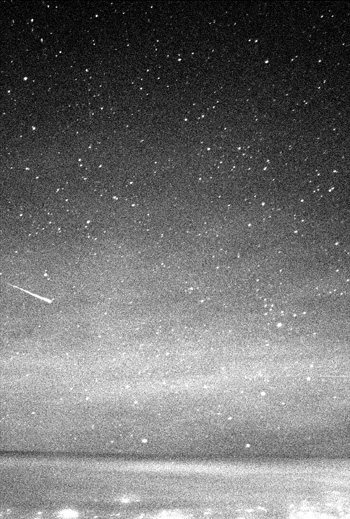
Quadrantid Meteor Shower. Image credit: NASA
With over 100 meteors per hour, the Quadrantid Meteor Shower is one of the latest mergers between Google and NASA, a major asset to space research due to their successful combination of ideas and plans. This peak shower began around 0200 UTC on Friday morning, January 4th, with the jet owned by the founders of Mountain View-based Google flying amongst big science players, such as the SETI research team.

To see this spectacular sight and to partake in a scientific mission, Google carried a team of NASA scientists and their high-technology instruments on board the Google owned Gulfstream V jet, which left the Mineta San Jose International Airport on Thursday late afternoon about 4:30 p.m. Plans were made for a ten-hour flight over the Arctic, returning to home base when the meteor shower mission was accomplished with the resulting data.

The GOOG Google.com Stock Message Board is full of the things that Google has been doing to improve the world—a real biggie was to develop a cheaper solar, wind power for Earth—excellent idea from a company whose corporate motto is to “do not be evil.” That plan involved the creation of a research group to develop energy sources that was a cheaper renewable alternative which focuses on solar, wind and any other forms of power through the Renewable Energy “Cheaper Than Coal” project. And of course, lowering Google's power bill was top of the list before anyone else as a huge incentive.

Last September, as most are aware of, NASA and Google had launched a $2.6 million dollar agreement to let the Google co-founders house their aircraft at Moffett Field while NASA was to be allowed to use it for their science work, such as that of the Quadrantid Meteor Shower. Other prospective plans for Google are to hand out $30 million dollars to any company that successfully comes up with a plan to bring people to the moon. Another plan is to fund a space race through Google's Lunar X Prize competition.

Original Source: NASA News Release

Universe Today : Book Review: Our Changing Planet

Written by Mark Mortimer

Our Changing Planet
A butterfly's flapping wings may alter the weather a thousand kilometres away. This marvel of chaos also symbolizes Earth's many interconnections. Such connections appear again and again in the book Our Changing Planet – The View From Space edited by M. King, C. Parkinson, K. Partington and R. Williams. Its collection of essays and vibrant depictions allow a reader to grasp meaning from random variability and arrive at a comprehension about the system that supports our lives on Earth.

The space age brought two great assets to weather forecasting; the satellite and computers. These tools allowed us to detect trends and relationships. For example, cold air over the Pacific Ocean during the spring time may lead to overly dry conditions along the west coast of the Americas. And, at a smaller scale, we see cities causing heat islands that effect their immediate climates. Through this experience, we can take current conditions and extrapolate them into the future. The goal is thus to ameliorate conditions, like tsunamis, that may be disadvantageous to human existence. However, this is a new field, so making predictions beyond a year, or perhaps a decade, still come with a great deal of uncertainty.

Nevertheless, we can make connections, and this book gives the reader an appreciation of what's been done with our knowledge and where we might be going. The four editors; King, Parkinson, Partington and Williams have included within their book over 60 independent essays so as to provide a perspective of the dynamics of Earth. Most of these are weather related, though selections on plate tectonics, glaciers and vegetation show how weather affects and is affected by so much. For example, aerosols from ship's exhaust cause a plume that satellites can detect well after the ship's moved on. As well, Ebola outbreaks have a direct association with the end of rainy seasons. Also included within the book are little tidbits of information. An average hurricane will condense 20,000 million tons of water a day. And, over 1% of global total emission of man-made sulphur dioxide come from a few smelters at Noril'sk in north central Siberia. As these demonstrate, there's little that can hide from today's satellite technology, and this book readily shows this to great avail.

Yet, this book particularly shines through its illustrations. The book is physically of an overly large format. With this, the editors provide broad, expansive colour images, usually from satellites. For instance, a dramatic two page spread shows the mighty Lambert Glacier flowing out to the ocean. However, the book's true bread and butter are the many GIS themed maps. Whether showing net primary productivity on a global scale or tsunami wave heights in the Indian Ocean, the reader is given simple yet informative visual pictures of the data. By providing a series of these maps, all annotated with dates, the reader can then easily grasp how our planet's features change over time and how they effect all of Earth's residents.

With the illustrations and their associated essays, the reader will see that the Earth changes. But, this isn't news to anyone. And, this is a weakness of the book. The editors have omitted the inclusion of a common theme to drive the reader through the book. General interest and appreciation of great illustrations will start the reader into the book, but it may not be enough to keep them going. There's an implicit understanding throughout the text that any change will affect humans. But, as people cover the globe, this comes as no surprise. Thus, the editors have missed an opportunity to build upon the knowledge. Especially, they've shied away from trying to combine trends seen from the individual case studies. It is apparent that the editors have gotten essays from very knowledgeable writers, but the writers appear to have worked mostly in isolation. Hence, aside from a general theme of a changing Earth, the essays have little that relate to each.

Nevertheless, this book makes for a great reference. In particular, it epitomizes the value of geographical information systems (GIS). With only rudimentary geographical knowledge, any reader can appreciate ebbs and flows across our globe. And, by the very nature of satellites, the reader will quickly forget about national boundaries and appreciate the inter-connected nature of our existence. However, this book keeps science within easy reach, more for the student or general reader than a researcher. Thus, though a wonderful reference either for data or for themes, this book is a starting point and a typical reader will be looking elsewhere to build upon the presentations.

With the Earth spinning by at well over 1600 kilometres an hour, many things get tossed and turned about. Add to this the effects of the occasional volcano and some very active residents, and, changes will abound. Such becomes readily apparent in the book Our Changing Planet – The View From Space edited by M. King, C. Parkinson, K. Partington and R. Williams. Through glowing illustrations and bright essays within it, our Earth becomes much more complete and more precious.

Read more reviews or purchase a copy online from Amazon.com