Google
 

Thursday, October 11, 2007

ESA : 2007 ozone hole ‘smaller than usual’

Ozone hole comparison
Ozone hole in 2006-2007


3 October 2007
The ozone hole over Antarctica has shrunk 30 percent as compared to last year's record size. According to measurements made by ESA’s Envisat satellite, this year’s ozone loss peaked at 27.7 million tonnes, compared to the 2006 record ozone loss of 40 million tonnes.

Ozone loss is derived by measuring the area and the depth of the ozone hole. The area of this year’s ozone hole – where the ozone measures less than 220 Dobson Units – is 24.7 million sq km, roughly the size of North America, and the minimum value of the ozone layer is around 120 Dobson Units.

A Dobson Unit is a unit of measurement that describes the thickness of the ozone layer in a column directly above the location being measured. For instance, if an ozone column of 300 Dobson Units is compressed to 0º C and 1 atmosphere (the pressure at the Earth’s surface) and spread out evenly over the area, it would form a slab of ozone approximately 3mm thick.


Average ozone loss

Average ozone loss in September
Scientists say this year’s smaller hole – a thinning in the ozone layer over the South Pole – is due to natural variations in temperature and atmospheric dynamics (illustrated in the time series to the right) and is not indicative of a long-term trend.

"Although the hole is somewhat smaller than usual, we cannot conclude from this that the ozone layer is recovering already,” Ronald van der A, a senior project scientist at Royal Dutch Meteorological Institute (KNMI), said.

"This year's ozone hole was less centred on the South Pole as in other years, which allowed it to mix with warmer air, reducing the growth of the hole because ozone is depleted at temperatures less than -78 degrees Celsius."


Ozone loss in the southern hemisphere

During the southern hemisphere winter, the atmospheric mass above the Antarctic continent is kept cut off from exchanges with mid-latitude air by prevailing winds known as the polar vortex. This leads to very low temperatures, and in the cold and continuous darkness of this season, polar stratospheric clouds are formed that contain chlorine.

As the polar spring arrives, the combination of returning sunlight and the presence of polar stratospheric clouds leads to splitting of chlorine compounds into highly ozone-reactive radicals that break ozone down into individual oxygen molecules. A single molecule of chlorine has the potential to break down thousands of molecules of ozone.

The ozone hole, first recognised in 1985, typically persists until November or December, when the winds surrounding the South Pole (polar vortex) weaken, and ozone-poor air inside the vortex is mixed with ozone-rich air outside it.

KNMI uses data from Envisat's Scanning Imaging Absorption Spectrometer for Atmospheric Chartography (SCIAMACHY) instrument to generate daily global ozone analyses and nine-day ozone forecasts.


Ozone is a protective layer found about 25 km above us mostly in the stratospheric stratum of the atmosphere that acts as a sunlight filter shielding life on Earth from harmful ultraviolet rays. Over the last decade the ozone layer has thinned by about 0.3% per year on a global scale, increasing the risk of skin cancer, cataracts and harm to marine life.

The thinning of the ozone is caused by the presence of ozone destructing gases in the atmosphere such as chlorine and bromine, originating from man-made products like chlorofluorocarbons (CFCs), which have still not vanished from the air but are on the decline as they are banned under the Montreal Protocol, which was signed on 16 September 1987.

Envisat can localise ozone depletion and track its changes, enabling the rapid estimation of UV radiation as well as providing forecasting. The three atmospheric instruments aboard Envisat are SCIAMACHY, the global ozone monitoring by occultation of stars (GOMOS) sensor and the Michelson interferometer for passive atmospheric sounding (MIPAS).


Envisat artist's impression

ESA data form the basis of an operational near-real time ozone monitoring and forecasting service forming part of the PROMOTE (PROtocol MOniToring for the GMES (Global Monitoring for Environment and Security) Service Element) consortium, made up of more than 30 partners from 11 countries, including KNMI.

As part of the PROMOTE and TEMIS service, the satellite results are combined with meteorological data and wind field models so that robust ozone and UV index forecasts can be made.

GMES responds to Europe’s needs for geo-spatial information services by bringing together the capacity of Europe to collect and manage data and information on the environment and civil security, for the benefit of European citizens.

The GMES Service Element (GSE) has been preparing user organisations in Europe and worldwide for GMES by enabling them to receive and evaluate information services derived from existing Earth Observation satellites since 2002.

Universe Today : Earth Had Oxygen Earlier Than Believed


Written by Fraser Cain

Vegetation changes seen from orbit. Image credit: NASA
Take a nice deep breath, fill your lungs with oxygen. You can thank the plants for that. Scientists had originally found that oxygen showed up in the Earth's atmosphere around 2.3-2.4 billion years ago; in a period called the "Great Oxidation Event". But there's new evidence, dug out of a rock in Australia, that puts that first date even earlier by 50-100 million years.

Researchers gathered samples from a region of Western Australia called Hamersley Basin. In one part of the kilometre-long rock sample, they found an ancient rock that shows how the atmosphere was switching over to the oxygen-rich air we enjoy today. Their research appeared in the September 28th issue of the journal Science.

According to one of the researchers, Ariel Anbar, from Arizona State University, "we seem to have captured a piece of time before the Great Oxidation Event during which the amount of oxygen was actually changing – caught in the act, as it were."

During the summer of 2004, researchers bored a 1 km long sample of rock out of Hamersley Basin in Western Australia, a region famous for keeping a geologic history of the Earth. Because the sample was so deep underground, it had been untouched for billions of years. The researchers sliced the sample and kept half in Australia, and took the other half back to the US.

They began to analyze ancient portions of the sample, looking for the trace metals molybdenum, rhenium and uranium. The amount of these metals found in ocean deposits depends on the amount of oxygen in the atmosphere. They found a region of time, ahead of the Great Oxidizing Event by about 100 million years, where oxygen was forming in the atmosphere.

It's thought that life started learning how to produce oxygen then, but everything that made was soaked up by geologic processes. It took 100 million years for the life to overcome those effects and start seeding the atmosphere with oxygen.

Of course, this discovery will help astronomers search for life on other planets in the galaxy. They will eventually be able to measure the oxygen content precisely, and identify what stage of evolution life on the distant planet could be at. If none have undergone a similar Great Oxidation Event, it tells us how rare life might be in the Universe.

Original Source: ASU News Release

Universe Today : Discovery Rolls Out to the Pad


Written by Fraser Cain

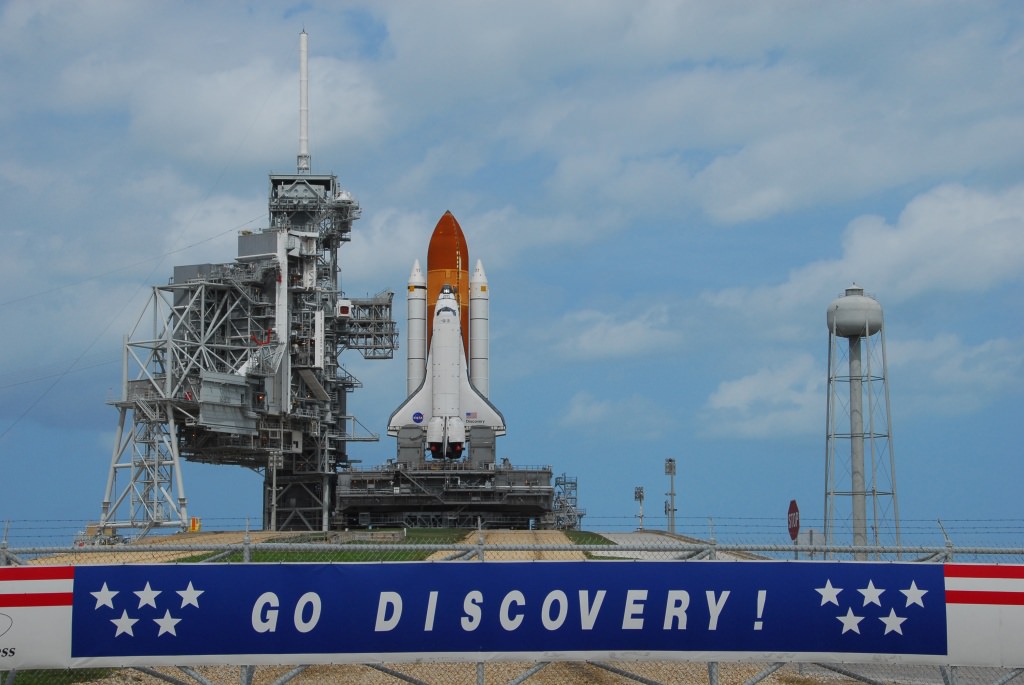
Space shuttle Discovery. Image credit: NASA
I know it feels like it was just yesterday that Endeavour returned from its mission to the International Space Station. With the new compressed space shuttle schedule, get used to it - NASA's got a lot of missions to schedule if they're going to hit their 2010 completion date of the International Space Station. Next up, Discovery. The shuttle was moved out to the launch pad on Sunday, and now awaits its October 23rd launch.

The shuttle made the 5.5 km (3.4 mile) journey from the Vehicle Assembly Building to its launch pad at NASA's Kennedy Space Center. It started out at 6:47 am EDT, and was firmly down at the launch pad at 1:15 pm. The huge crawler transporter only moves about 1.6 kph (1 mph), so it's really slow going.

With the shuttle on the pad, everyone still has a series of activities to complete before the beginning of mission STS-120. The crew will arrive on October 7th, and perform a dress rehearsal on October 10th.

If all goes well, Discovery will blast off on October 23rd, once again bound for the International Space Station. The shuttle will be carrying the US-built Harmony module. This six-hatched cylinder will serve as a pressurized gateway to attach future science laboratories to the station.

The STS-120 crew is led by Pam Melroy, only the second woman ever to command a space shuttle mission.

Original Source: NASA News Release

Universe Today : Lunar Probe's High Definition View of the Earth


Written by Fraser Cain

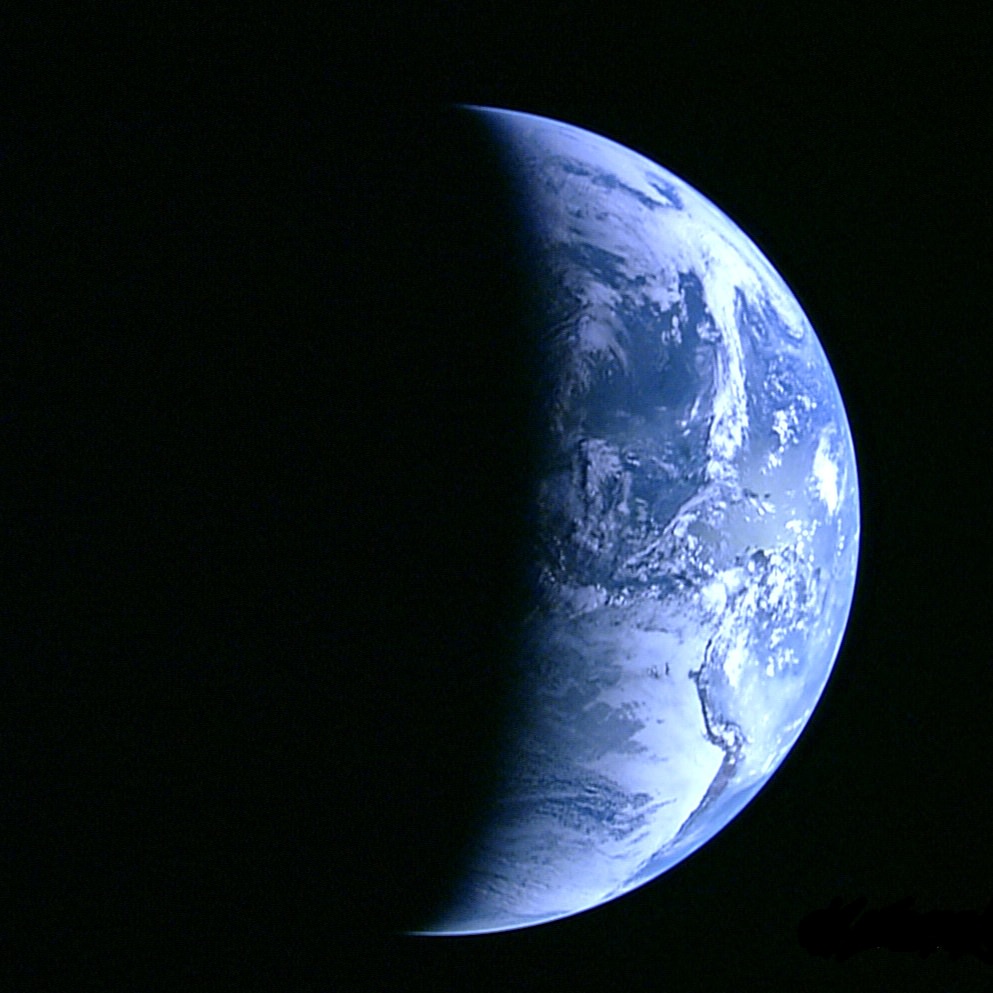
The Earth in high definition. Image credit: JAXA
There's nothing as nice as a pretty view of our home planet. It really puts things in perspective. I'm on that planet, and so are you. It's a high definition image of the Earth, of course, captured on September 29th by the Japanese spacecraft Kaguya (aka Selene) from a distance of 110,000 km. It's currently in Earth-orbit, but on October 3rd, it'll begin transferring its orbit to the Moon.

As to the actual mission, here's an article we posted a couple of weeks ago, when the spacecraft was launched. We'll report back with further updates, for now, just enjoy the pretty picture.

Original Source: JAXA News Release

And the Winner of the NASA Slogan Contest Is....


By Loretta Hidalgo Whitesides EmailOctober 01, 2007 | 12:09:41 PMCategories: Space

ReachExploring Other Worlds, Understanding Our Own
2nd NASA: Explorers Wanted
3rd NASA: Bringing the Universe to Your Doorstep

And the one that made me laugh the hardest:
NASA: We Find Your Lack of Faith Disturbing

After sifting through over 4,000 entries by hand, I am pleased to share with you the Top 25 NASA tagline submissions and the Top 5 humorous submissions (after the jump). I hope you will enjoy them as much as I did and I hope that we will find ways to put all this crowd sourcing effort to good use!
Over the past month, this crowd sourcing article was viewed by over 50,000 people. I just want to thank everyone who read it, passed it on, blogged about it and especially those that submitted.

See full list of finalists after the jump.

What I came to see as I was reading them was that NASA needs a tagline that invites people in, that is about the user not the provider. It is like HP's "Invent", or Play Station's "Live in Your World, Play in Ours." They are not descriptive like "Building the best games on the planet" or "Printers that last" They are an invitation, a focus on what the user can do -the ultimate is "Be all that you can be."

In the new world of Web 2.0, participatory exploration and crowd sourcing maybe that is something for us all to keep in mind. That is why two of the three finalists were about YOU.

If you submitted the winning entry or any of the top 4 finalists, please email loretta@spacegen.org for more details.

Top 25 NASA Tag Line Submissions (alphabetical with top three winners noted)
A Universe of Possibilities
Bringing the Future Down to Earth
Bringing the Universe to Your Doorstep*
Creating the Future
Creating the Future Since 1958
Experience the Universe
Explore
Explorers Wanted*
Exploring Other Worlds, Understanding Our Own*
Exploring Our Universe
Exploring the Future
Exploring the Possibilities
For the Benefit of all Mankind
Fueling Imagination
Go Beyond
Humanity, You Are 'Go' for Launch
Infinite Possibility
Innovation Through Exploration
Inspire. Innovate. Explore
Launching the Future
Now Boarding
Searching the Stars. Finding Ourselves.
The Evolution Continues
The Universe is Waiting
We Have Ignition

Top 5 Funny Submissions
Ad Astra, Per Asparagus
NASA: Houston, better make that a double
NASA: We find your lack of faith disturbing*
Well, at least the war on science is going well
NASA: 87.5 times faster than NASCAR

And just added at the commenters request:
The Top 15 Vote Getters on the Reddit Tool


Ups Downs Total Submission
1 4976 1725 3251 All your space are belong to U.S.
2 3745 1456 2289 NASA: Billions Of Dollars Spent and Still No Death Star
3 1906 873 1033 NASA: Because one does not simply walk into space.
4 1492 716 776 See the Moon? Yeah, we hit that.
5 2733 2133 600 SO I HERD U LIEK MUDKIPZ
6 1383 858 525 NASA: Our Janitor Is Smarter Than The President
7 1816 1299 517 NASA: Actually this *is* rocket science.
8 736 452 284 NASA: Because Intelligent life is so hard to find these days.
9 747 587 160 NASA: In 100 years, you'll wish you'd given us more funding.
10 1238 1081 157 NASA: Tonight, We Dine, IN SPACE
11 1005 938 67 BRB, Going to the Moon
12 300 236 64 Think Outside The Globe.
13 1101 1065 36 NASA: Our mission is to stick it in Uranus
14 78 70 8 NASA: When I was your age, Pluto was a planet
15 900 893 7 NASA: What We Could Do With The Billions Wasted In Iraq...

The image of the little boy is from a commercial that a team of artists and producers submitted to NASA called "Reach." It is very much worth watching if you haven't see it before and is viewable here.

Original Post and first 70 comments:
Can You Write a Better Slogan for NASA? [Wired Science]

Two Weeks to go Before Spaceward Games 2007 AKA The Space Elevator Games


In two weeks time the first of 24 teams will will begin qualifications in the Space Elevator Power Beaming and Tether Strength Competition for a chance at a $1,000,000 offered by NASA through its Centennial Challenges.

The Spaceward Games 2007 of which the The Space Elevator Games is a part of this year is being held at the Davis County Event Center just north of Salt Lake City, Utah between October 15-21 with the Space Elevator Games qualifying starting on the 15th. The public portion of the games will begin on October 19th and run through the 21st.

In addition to the Space Elevator competition the Spaceward Games will also feature the 2007 Great Light-Racer Championship (GLRC). Here's how Spaceward describes the GLRC:

"The Great Light-Racer Championship is a technology and science competition designed for parent/child, teacher/students, or RC car hobbyist teams. The teams compete in solving a real NASA lunar exploration problem: building a rover that can operate in a permanently shadowed area of the moon. Competition rovers consist of an electric RC car, modified to operate using a beam of light as its power source."

The Spaceward Games 2007 is a perfect event for the family providing insight into future technologies as well as educating young and old alike in an entertaining environment. The crew from the Space Elevator Reference will be attending and reporting on the daily events as they happen.

ESA : Extreme star cluster in new Hubble images


printer friendly page

Nebula NGC 3603
Nebula NGC 3603

2 October 2007
The gigantic nebula NGC 3603 hosts one of the most prominent, massive, young clusters in the Milky Way. Hubble has been observing this prime location for star formation studies.

NGC 3603 is located in the Carina spiral arm of the Milky Way, about 20 000 light-years from the Solar System.

Images from the NASA/ESA Hubble Space Telescope show a young star cluster surrounded by a vast region of dust and gas. Most of the bright stars in the image are hot, blue stars. They produce ultraviolet radiation and violent winds that have formed an enormous cavity in the gas and dust surrounding the cluster.


Zooming into NGC 3603
The image shows many stars with differing masses but similar ages inside the young cluster. Stars of different masses evolve at a different pace, so this makes it possible to study several types of stars at varying stages in their lives, in detail. Astronomers can compare clusters of different ages with one another and determine which properties (such as temperature and brightness) change as the stars get older.


Nebula NGC 3603
Nebula NGC 3603

Dr Jesús Maíz Apellániz from Instituto de Astrofísica de Andalucía, Spain, is leading the Hubble investigation. According to him, the cluster appears to gather the most massive stars at its core. His team has discovered that the distribution of different types of stars at the centre of this dense cluster is similar to that of other young clusters in the Milky Way.

Apellániz's team has also found that the three brightest stars in the centre appear to be more massive than theoretical limits allow. In fact, these ‘heavyweights’ may actually consist of two or perhaps more individual massive stars whose light has blended together. Even with Hubble’s resolution, it is not possible to separate the individual stars in each of the three systems.


The heart of NGC 3603

This finding agrees with a recent discovery by Dr. Anthony Moffat from the Université de Montréal, Canada. He used ESO’s Very Large Telescope (VLT) and Hubble’s Near Infrared Camera and Multi-Object Spectrograph (NICMOS) to measure the movements of the individual stars in two of the three systems. Dr. Moffat measured the largest star’s mass to be roughly 115 times that of the Sun - which is within acceptable limits for conventional theory.


A wide-field image of the Milky Way
The Milky Way

The swirling nebula of NGC 3603 contains around 400 000 solar masses of gas. Lurking within this vast cloud are a few Bok globules, named after Bart Bok who first observed them in the 1940s.

Bok globules are dark clouds of dense dust and gas with masses of about ten to fifty times that of the Sun. They resemble insect cocoons and are in the process of collapsing under their own weight, forming new stars. Bok globules appear to be some of the coldest objects in the Universe.

NGC 3603 was first discovered by Sir John Herschel in 1834. It is known to harbour a blue supergiant star called Sher 25, believed to be on the verge of exploding as a supernova. It is often known as the Milky Way counterpart of the predecessor of the now-famous supernova SN 1987A in the Large Magellanic Cloud.


A wide-field image of the region of NGC 3603
The region of NGC 3603

Universe Today : True or False (Color): The Art of Extraterrestrial Photography


Written by Nancy Atkinson

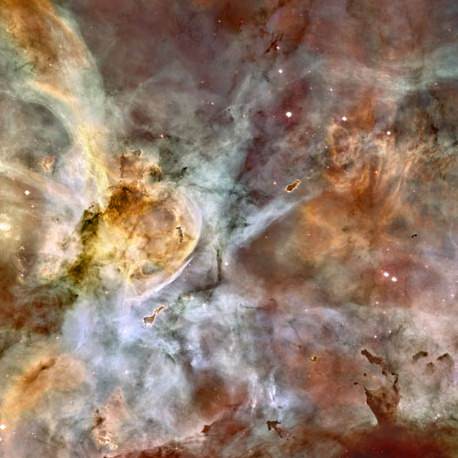
Carina Nebula. Image credit: Hubble
When you look at the amazing pictures captured by Hubble, or the Mars Exploration Rovers, do you ever wonder: is that what you'd really see with your own eyes? The answer, sadly, is probably not. In some cases, such as with the Mars rovers, scientists try and calibrate the rovers to see in "true color", but mostly, colors are chosen to yield the most science. Here's how scientists calibrate their amazing instruments, and the difference between true and false colors.

Question: True or false: When we see the gorgeous, iconic images from the Hubble Space Telescope or the stunning panoramas from the Mars Exploration Rovers, those pictures represent what human eyes would see if they observed those vistas first hand.

Answer: For the Hubble, mostly false. For the rovers, mostly true, as the rovers provide a combination of so-called "true" and "false" color images. But, it turns out, the term "true color" is a bit controversial, and many involved the field of extraterrestrial imaging are not very fond of it.

"We actually try to avoid the term 'true color' because nobody really knows precisely what the 'truth' is on Mars," said Jim Bell, the lead scientist for the Pancam color imaging system on the Mars Exploration Rovers (MER). In fact, Bell pointed out, on Mars, as well as Earth, color changes all the time: whether it's cloudy or clear, the sun is high or low, or if there are variations in how much dust is in the atmosphere. "Colors change from moment to moment. It's a dynamic thing. We try not to draw the line that hard by saying 'this is the truth!'"

Bell likes to use the term "approximate true color" because the MER panoramic camera images are estimates of what humans would see if they were on Mars. Other colleagues, Bell said, use "natural color."

Zolt Levay of the Space Telescope Science Institute produces images from the Hubble Space Telescope. For the prepared Hubble images, Levay prefers the term "representative color."

"The colors in Hubble images are neither 'true' colors nor 'false' colors, but usually are representative of the physical processes underlying the subjects of the images," he said. "They are a way to represent in a single image as much information as possible that's available in the data."

True color would be an attempt to reproduce visually accurate color. False color, on the other hand, is an arbitrary selection of colors to represent some characteristic in the image, such as chemical composition, velocity, or distance. Additionally, by definition, any infrared or ultraviolet image would need to be represented with "false color" since those wavelengths are invisible to humans.

The cameras on Hubble and MER do not take color pictures, however. Color images from both spacecraft are assembled from separate black & white images taken through color filters. For one image, the spacecraft have to take three pictures, usually through a red, a green, and a blue filter and then each of those photos gets downlinked to Earth. They are then combined with software into a color image. This happens automatically inside off-the-shelf color cameras that we use here on Earth. But the MER Pancams have 8 different color filters while Hubble has almost 40, ranging from ultraviolet ("bluer" than our eyes can see,) through the visible spectrum, to infrared ("redder" than what is visible to humans.) This gives the imaging teams infinitely more flexibility and sometimes, artistic license. Depending on which filters are used, the color can be closer or farther from "reality."

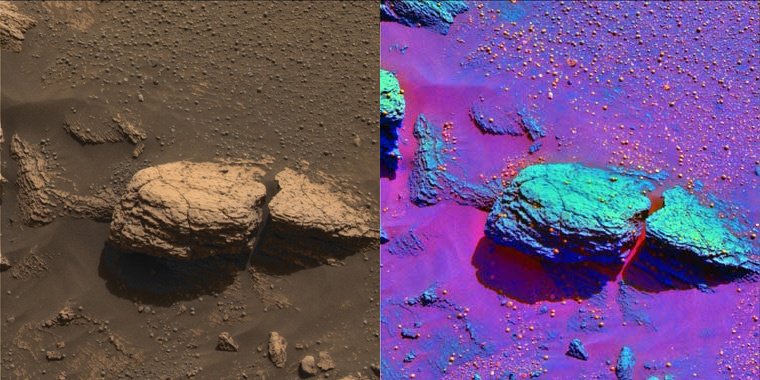
Stone mountain rock outcrop in true and false colour. Image credit: NASA/JPL
The same rock imaged in true and false color by Opportunity.

In the case of the Hubble, Levay explained, the images are further adjusted to boost contrast and tweak colors and brightness to emphasize certain features of the image or to make a more pleasing picture.

But when the MER Pancam team wants to produce an image that shows what a human standing on Mars would see, how do they get the right colors? The rovers both have a tool on board know as the MarsDial which has been used as an educational project about sundials. "But its real job is a calibration target," said Bell. "It has grayscale rings on it with color chips in the corners. We measured them very accurately and took pictures of them before launch and so we know what the colors and different shades of grey are."

One of the first pictures taken by the rovers was of the MarsDial. "We take a picture of the MarsDial and calibrate it and process it through our software," said Bell. "If it comes out looking like we know it should, then we have great confidence in our ability to point the camera somewhere else, take a picture, do the same process and that those colors will be right, too."

Hubble can also produce color-calibrated images. Its "UniverseDial" would be standard stars and lamps within the cameras whose brightness and color are known very accurately. However, Hubble's mission is not to produce images that faithfully reproduce colors. "For one thing that is somewhat meaningless in the case of most of the images," said Levay, "since we generally couldn't see these objects anyway because they are so faint, and our eyes react differently to colors of very faint light." But the most important goal of Hubble is produce images that convey as much scientific information as possible.

The rover Pancams do this as well. "It turns out there is a whole variety of iron-bearing minerals that have different color response at infrared wavelengths that the camera is sensitive to," said Bell, "so we can make very garish, kind of Andy Warhol-like false color pictures." Bell added that these images serve double duty in that they provide scientific information, plus the public really enjoys the images.

And so, in both Hubble and MER, color is used as a tool, to either enhance an object's detail or to visualize what otherwise could not be seen by the human eye. Without false color, our eyes would never see (and we would never know) what ionized gases make up a nebula, for example, or what iron-bearing minerals lie on the surface of Mars.

As for "true color," there's a large academic and scholarly community that studies color in areas such as the paint industry that sometimes gets upset when the term "true color" is used by the astronomical imaging group. "They have a well-established framework for what is true color, and how they quantify color. But we're not really working within that framework at that level. So we try to steer away from using the term 'true color'."

Levay noted that no color reproduction can be 100% accurate because of differences in technology between film and digital photography, printing techniques, or even different settings on a computer screen. Additionally, there are variations in how different people perceive color.

Bell concluded, "What we’re doing on Mars is really just an estimate, it's our best guess using our knowledge of the cameras with the calibration target. But whether it is absolutely 100% true, I think it's going to take people going there to find that out."

For more information see http://hubblesite.org/ or check out Jim Bell’s 2006 book “Postcards From Mars.”

ESA : Successful test of Jules Verne ATV software


printer friendly page
The Automated Transfer Vehicle
ATV software was integrated into the whole ISS software ground testbed


28 September 2007
For the first time, the compatibility of the final Jules Verne Automatic Transfer Vehicle flight software has been successfully tested this month with the rest of the vast ISS flight software by international teams at the NASA Software Verification Facility (SVF) in Houston.

This ISS-level stage test, the so-called ’five-box’ test, is a new step where the ATV software is integrated into the whole ISS software ground testbed. It was conducted for 12 days over three weeks by some 43 engineers from NASA, ESA, Astrium, RSC-Energia and Boeing at the SVF Software Development and Integration Laboratory (SDIL), a few miles from NASA's Johnson Space Center. Another 30 people behind the scenes also provided support on site, in Russia and Europe.


For the ATV it is a trilateral test with the Russians playing a key role, as the Jules Verne re-supply spaceship will dock with the Russian Service Module. "The ATV Stage Integration Test was very successful and surpassed all of our expectations. This test demonstrated the integrated flight software functionality across the US segment, the Russian segment, and the ESA ATV vehicle for the timeframe in which the ATV is docked to the ISS. This success is the result of years of hard work and demonstrates the tremendous commitment of all three international partners, working together toward a common objective," said Susan Creasy, NASA ISS Avionics and Software Office Manager.


Sonny Carter Training Facility
NASA's Sonny Carter Training Facility in Houston

This unique SDIL facility replicates the complete ISS on-board avionics. The facility is being extended as new elements from the ISS’s international partners are attached to the Space Station. It is located at the Sonny Carter Training Facility, the site of the world's largest indoor pool, which contains a fully immersed mockup of the ISS so that astronauts can train for spacewalks.

Test and verification of all ISS flight software is done at the SDIL, a world class infrastructure which houses over 800 computers. Its purpose is to provide a full confidence in the safety and efficiency between the different elements of the ISS for mission-critical software.

The Jules Verne ATV, which is scheduled to be launched in early 2008, is known as the ‘fifth box’, in this five-box test, which includes the two Fault Tolerant Computers (FTCs) of the Russian Service Module, the two MDM computers of the US Destiny Lab and for the first time, the ATV. Similar testing is required for ESA’s Columbus module and the Japanese Kibo module. On board the ATV, the FTC, which is the main 3-unit computer, and its flight application software play the role of a pilot that navigates the ATV mission.


ISS - 19 August 2007
The safety of the 220-tonne orbital outpost depends on smooth communication across the software

“This test campaign has been a full success. With our NASA and RSC-Energia partners we have been able to run according to plan many different scenarios and about 70 test cases – including many with failures created on purpose. Even if most of the procedures had already been tested in Moscow several months ago in a different test facility, now we have conducted the final confidence test under NASA authority in an ISS representative environment,” says Klaus Ludwig, ESA software manager on the ATV programme, who was in Houston for the test.

The complexity of the different software and their compatibility will play a crucial role during the attached phases such as the re-boost operation, the debris avoidance manoeuvres and the desaturation of the Space Station’s gyroscopic attitude system while the ATV is attached to the ISS. The safety of the whole 220-tonne orbital outpost depends on smooth communication across the module software of the different partners. The flight code on the US side and the Russian side contains over four million lines of code and there are about one million lines of code in the various computers of the ATV spaceship.


The SDIL facility
Inside the Software Development and Integration Laboratory facility

“This flight software functionality across the whole Space Station is crucial since no vital system is centralised in only one of the modules of the Station. Instead these systems are spread over several modules and work as one major network, such as the orientation control system”, said ESA astronaut Jean-François Clervoy, senior advisor to the ATV programme,

For those dedicated tests in the SVF, key elements of the real flight hardware, such as the ATV FTC, are connected to a high fidelity ATV simulator which reproduces the different scenarios and behaviour of the European spaceship, and a replica of the onboard data management system. Thanks to this complex infrastructure, with its interconnecting flight hardware, powerful computers and numerous pieces of software and synchronised simulation systems from all partners, it is as if the avionics bay of the ATV is actually flying in orbit with the rest of the ISS.

The facility in Houston will be continuously available to simulate on the ground, with the ATV software, any orbital scenarios of the five ATV missions planned between 2008 and 2015.


Notes for editors

Jules Verne is the first of a series of ATVs which will bring supplies including food, water, and fuel as well as experiment equipment to the crew on board the International Space Station. A crucial element of the ISS programme, the ATV will also re-boost the Station’s orbit to overcome the effects of residual atmospheric drag. After six months the ATV will undock and be used to dispose of Station waste during a guided and controlled destructive re-entry into the atmosphere high over the Pacific Ocean.

Space.com : The Scientific Legacy of Sputnik


By Ker Than
Staff Writer
posted: 02 October 2007
06:33 am ET

Fifty years ago this week, Sputnik Chief Designer Sergei Korolyov watched as a modified Russian missile launched into space from Kazakhstan's lonely steppes carrying a very special payload.

Sputnik 1 ("traveling companion" in Russian) was about the size of a basketball and weighed about 180 pounds. It was equipped with two radio transmitters and four long antennas that broadcasted a constant beep while circling the Earth for 21 days.

Sputnik's launch stunned the world and changed it, too. It heralded in dramatic fashion a new "space age," created an identity crisis in the United States, led to the creation of NASA and began a flurried race between the world's two superpowers to place a human on the moon.

Sputnik touched all walks of life. For politicians, its launch provided a new and powerful way to stir up patriotism. Winning the space race was not only a matter of national security, they said, but of national pride.

For engineers, the space age represented a new set of daunting technological hurdles to be overcome. The engineers were the group tasked with inventing machines capable of escaping Earth's gravity and reaching the moon, as well as ways to keep humans alive in space and to communicate with them from the ground.

For people of a military mindset, Sputnik represented an awesome and frightening new way of waging war. The same technology needed to loft a satellite into space could also be adapted to hurl a nuclear warhead at your enemies from half a world away.

For environmentalists, the photographs of our planet in full that came out of the space age were a powerful propaganda tool. The "Blue Marble" image taken by the crew of Apollo 17 spoke volumes about Earth's fragility and the interconnectedness of life and humanity.

But all of these things would come later. Arguably the first people to fully grasp Sputnik's significance and to exploit its technology were scientists for whom the beeping metal ball represented a radical new way of studying our planet and the universe.

Scientists made their first major discovery of the space age a mere three months after Sputnik's launch. American scientist James Van Allen convinced engineers to strap a Geiger counter his team had designed to the first American satellite, Explorer 1, launched on January 31, 1958. The experiment confirmed the existence of Earth's magnetic field by detecting a doughnut-shaped region of high- energy particles encircling the planet. Scientists now know Earth has two such "Van Allen Belts" which can be hazardous to both satellites and astronauts.

Boost for science

Sputnik's launch forced Americans to rethink the notion that they were the world's most technologically advanced nation. "Many people were flabbergasted that the Russians, of all people, could do it," recalled William Burrows, author of This New Ocean, a detailed chronicle of the space age.

"The Communists bragged that they invented the airplane, radio, television, rockets and so on, so Americans made jokes that [they] probably also took credit for inventing baseball and bubble gum," Burrows said. "We laughed and ridiculed them. Then Sputnik. POW! They really did have muscle."

What followed was an unprecedented push in the United States to educate the nation's youth in science and mathematics. In 1958, Congress passed the National Defense Education Act to provide scholarships for aspiring scientists, engineers and mathematicians.

"Sputnik made everybody think about science and technology more seriously," said David Thompson, an astrophysicist at NASA Goddard Space Flight Center in Maryland.

Aspiring astronomers

The U.S. government's push for scientific education was made easier in many ways by Sputnik. The satellite was a technological marvel that inspired an entire generation of students—and not just aspiring engineers. Some astronomers trace their interest in space to the Sputnik-era.

"Everybody was going out to try to see these satellites that had just been launched and I went out and said 'You know, these other things in the sky are more interesting,'" Thompson said. "There are stars out there and planets.'"

"I was a kid and it sounded very exciting," said Mario Livio, a senior astronomer at the Space Science Telescope Institute in Maryland. "At the time, the first name that I remembered for this was an 'artificial moon.' That of course had its own feelings that went with it: 'Humans have created their own artificial moon.'"

Lasting legacy

For many scientists, Sputnik's greatest legacy is the space observatories such as Hubble that it paved the way for.

Space telescopes "opened up new wavelength regimes or bettered the capabilities in a given regime by a factor of ten" compared to ground telescopes, Livio told SPACE.com.

"The studies of the microwave background from space started with COBE and continued through to WMAP," said Steven Weinberg, a Nobel laureate in physics who works at the University of Texas in Austin. "That has really made cosmology into a precision science and given us our best evidence about inflation."

Others think Sputnik's contributions to science are more subtle. The space age also encouraged scientists in all disciplines to entertain new ideas, said spaceflight historian Roger Launius, chair of the Division of Space History at the Smithsonian Institution's National Air and Space Museum in Washington, D.C.

"We had no idea in the past until we started to explore space what the potential hazards as well as opportunities there were out there," Launius said. "When did the theory that the dinosaurs had a sudden mass extinction as a result of an asteroid emerge? Had we not flown in space, we would never have even considered that as a possibilit